Are Dental Braces Safe for an MRI? What Every Patient Needs to Know
Finding out you need a Magnetic Resonance Imaging (MRI) scan can be stressful enough on its own without the added worry of whether your orthodontic treatment will cause complications. For patients with braces, a common wave of panic often sets in: Will the machine pull the braces off my teeth? Will the metal heat up? Will the images be ruined?
These are valid questions. After all, we are constantly told that metal and magnets do not mix. Since MRI machines utilize powerful magnetic fields to generate detailed images of the body, it is only natural to worry about having metal brackets and wires cemented to your teeth during the procedure.
The good news is that for the vast majority of patients, having an MRI while wearing braces is safe. However, while physical danger is rare, there are significant nuances regarding image quality and preparation that you need to understand. This guide will walk you through everything you need to know about navigating an MRI with braces, ensuring you feel confident and prepared when you step into the imaging room.
Quick Answer: Can You Have an MRI with Dental Braces?
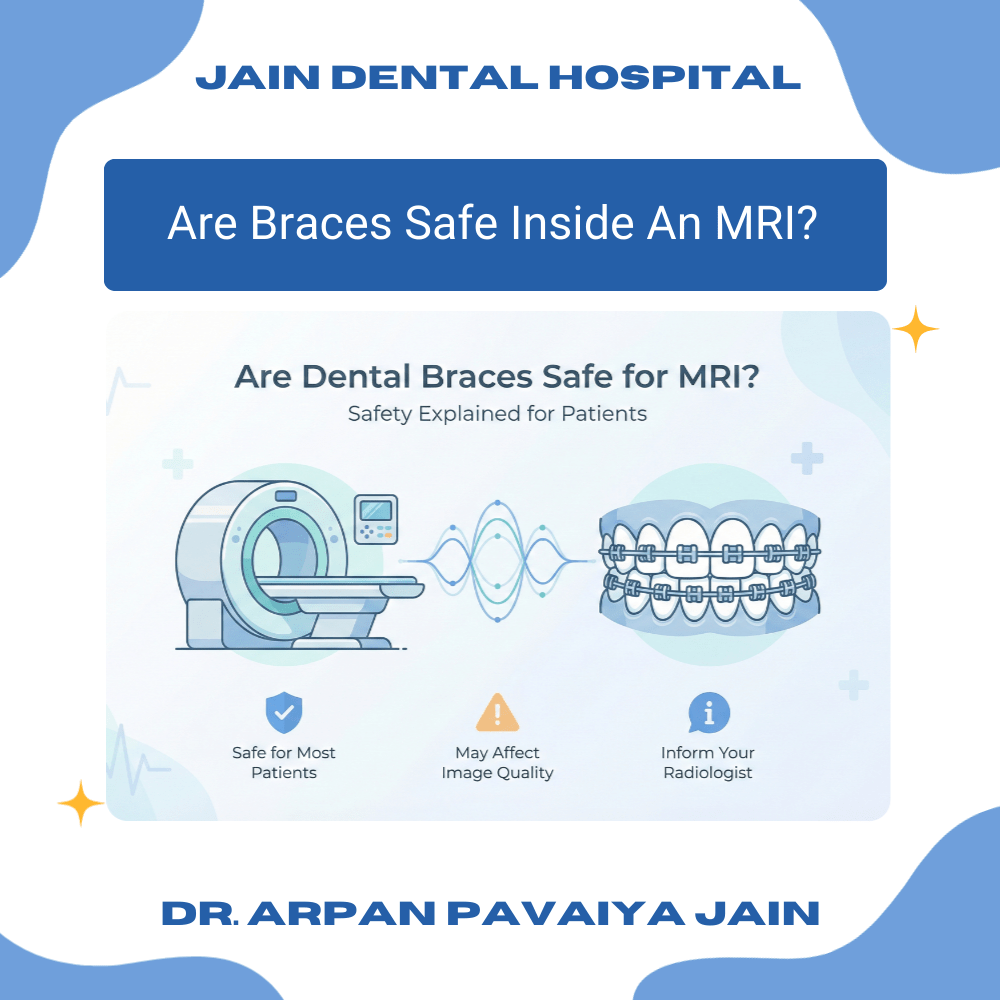
If you are looking for a simple “yes” or “no,” the answer is generally yes. You can safely undergo an MRI scan while wearing dental braces. Most modern orthodontic appliances are made from materials that are not strongly magnetic, meaning they will not be ripped from your mouth or cause injury during the scan.
However, while safety is rarely the issue, image clarity is. The metal in your braces can interfere with the magnetic field, creating “artifacts”—blurry or blacked-out spots on the scan. This is typically only a problem if the MRI is examining your brain, head, neck, or jaw. If you are having an MRI of your knee, spine, or chest, your braces will likely have zero impact on the results.
In short, you do not need to panic, but you do need to communicate. Always inform your radiologist and technician that you have braces before your appointment so they can make the necessary adjustments to their equipment and protocols.
How MRI Scans Work (And Why Metal Matters)
To understand why braces are a concern, it helps to understand how the technology works. MRI stands for Magnetic Resonance Imaging. Unlike X-rays or CT scans, which use ionizing radiation, an MRI uses a combination of radio waves and an incredibly powerful magnetic field to create detailed cross-sectional images of your internal organs, soft tissues, and bones.
The strength of this magnetic field is measured in Tesla (T). Most standard clinical MRI machines operate at 1.5 Tesla or 3 Tesla. To put that in perspective, a 3 Tesla magnet is roughly 60,000 times stronger than the Earth’s magnetic field. This massive power is why patients are strictly instructed to remove jewelry, watches, and loose metal objects before entering the room—those items can become dangerous projectiles.
Because braces are fixed to your teeth and cannot be removed in the changing room, they interact with the machine differently. The concern isn’t just about the metal moving; it is about how the metal alters the magnetic field locally. Ferromagnetic metals (like iron) react strongly to magnets, while non-ferromagnetic metals (like titanium or high-grade stainless steel) create much weaker reactions. Understanding this distinction is key to understanding why modern braces are generally safe.
Types of Dental Braces and Their MRI Compatibility
Not all braces are created equal. The material your orthodontist used to align your teeth plays a massive role in how your braces will react inside an MRI scanner. While you might just see “metal,” the specific alloy determines both safety and the level of image distortion.
Stainless Steel Braces
Stainless steel is the most common material used for traditional braces. These brackets and wires are strong, durable, and effective.
- MRI Impact: While generally safe regarding movement, stainless steel causes the most significant “artifacting” or image distortion. The metal can cause a black void or a starburst pattern to appear on the image, potentially obscuring views of the mouth, sinuses, or brain.
- Safety: They may warm up slightly during long scans, but usually not to a painful degree.
Ceramic Braces
Ceramic braces are popular for their aesthetic appeal, as the brackets are tooth-colored or clear.
- MRI Impact: The brackets themselves are made of ceramic, which is non-conductive and non-magnetic. However, the archwire connecting the brackets is almost always metal.
- Safety: These produce significantly less image distortion than full metal braces. The metal wire may still cause minor artifacts, but the overall interference is reduced.
Lingual Braces
Lingual braces are cemented to the back of the teeth (the tongue side) rather than the front, making them invisible when you smile.
- MRI Impact: Because they are often custom-made using gold alloys or stainless steel and are positioned internally, they can create complex artifacts.
- Safety: Their location can make it particularly difficult to get clear images of the tongue or soft palate, but they pose no higher safety risk than traditional braces.
Clear Aligners (E.g., Invisalign)
Clear aligners have revolutionized orthodontics, using removable plastic trays to shift teeth.
- MRI Impact: These are the easiest to manage. Because they are made of medical-grade plastic, they are completely invisible to the MRI machine.
- Safety: You will simply be asked to remove your aligners before the scan, just as you would remove a retainer. There is zero risk of interference.
Which Type of Braces Is Most MRI-Friendly?
| Orthodontic Appliance | MRI Safe? | Level of Image Distortion | Heating Risk | Removal Before MRI? | Best For Patients Needing Frequent MRI |
| Stainless Steel Braces | ✅ Yes | High (especially for brain, head & neck MRI) | Very Low (mild warming possible) | Rarely (only for high-precision brain scans) | ❌ Not Ideal |
| Ceramic Braces | ✅ Yes | Moderate (less than metal braces) | Very Low | Rarely | ⚠ Better than metal |
| Lingual Braces | ✅ Yes | Moderate to High (position-dependent artifacts) | Very Low | Occasionally (case-specific) | ⚠ Depends on scan type |
| Clear Aligners (e.g., Invisalign) | ✅ Yes | None (removed before scan) | None | Yes (simply remove tray) | ✅ Most MRI-Friendly |
| Fixed Retainers | ✅ Yes | Low to Moderate | Very Low | No | ⚠ Generally Acceptable |
Are Dental Braces Dangerous During an MRI?
Safety is naturally the top priority for any patient. The idea of metal being inside a giant magnet sounds frightening, but decades of clinical experience and research have shown that the physical risks are minimal. Let’s break down the two main safety fears: movement and heating.
Do braces move inside the mouth?
A common myth is that the MRI magnet is strong enough to rip braces off teeth. In reality, modern orthodontic adhesives are incredibly strong—designed to withstand the high forces of chewing and biting. Furthermore, the alloys used in brackets (even stainless steel) are generally only weakly magnetic. The force exerted by the MRI is nowhere near strong enough to break the adhesive bond. You might feel a very subtle “tugging” sensation, but your braces will not come loose.
Risk of heating?
The radio frequency energy used in an MRI can cause conductive materials to heat up. This is a known phenomenon known as specific absorption rate (SAR). Research indicates that while braces can absorb some energy, the temperature rise is usually less than 1 degree Celsius. This is barely noticeable. In very rare cases, patients report a tingling or slight warming sensation, but burns or serious injuries are virtually unheard of with standard orthodontic appliances.
Can Dental Braces Distort MRI Images?
While your safety is assured, the diagnostic quality of your scan is a different story. This is the real challenge radiologists face when scanning patients with braces. The presence of metal creates a “susceptibility artifact.” Essentially, the metal bends the magnetic field around it, confusing the computer that generates the image.
This does not matter if you are having a scan of your foot, knee, or abdomen. The distance between your mouth and the area being scanned is great enough that the magnetic field in the target area remains uniform.
However, if you require an MRI of the brain, orbits (eye sockets), sinuses, or cervical spine (neck), the distortion can be problematic. The artifact typically appears as a large black smudge or a bright, distorted flare that can hide anatomy. For example, a stainless steel bracket might create a distortion large enough to obscure the pituitary gland or the frontal lobe of the brain. In these cases, the radiologist must decide if the scan is readable or if the braces prevent a clear diagnosis.
Will You Need to Remove Braces Before an MRI?
The thought of having your braces removed early, only to have them put back on later, is frustrating and expensive. The good news is that removal is rarely required. In 90% of cases, the scan proceeds with the braces in place.
However, there are specific medical scenarios where removal becomes necessary. If a patient needs a precise image of the brain or head to diagnose a critical condition—such as a tumor, aneurysm, or stroke—and the braces are creating artifacts that hide the problem area, the medical need takes precedence over the orthodontic treatment.
In these instances, you may not need to remove the entire system. Often, the radiologist will consult with your orthodontist to see if removing just the archwires (which often span the whole mouth and create a “cage” effect) will solve the problem. Removing wires is a quick, inexpensive procedure. Full bracket removal is a last resort and is usually only requested for high-precision scans of the face or skull base.
Modern implant materials are selected not only for strength and appearance but also for safety in medical environments. Their design considers long-term health needs, including future imaging tests.
What Should You Tell Your Radiologist Before an MRI?
Communication is your best tool for a safe and successful MRI. Never assume the technician notices your braces, and never wait until you are sliding into the machine to mention them. The radiology team can adjust the scanner settings (using sequences that are less sensitive to metal) to minimize artifacts, but only if they know in advance.
Here is your disclosure checklist:
- Notify at booking: Tell the scheduler you have braces when you make the appointment.
- Details matter: If possible, ask your orthodontist for the specific material of your braces (e.g., “300-series stainless steel” or “titanium”).
- Recent changes: Mention if you have had any recent adjustments or if you have any loose brackets.
- Other appliances: Don’t forget to mention permanent retainers behind your teeth, palatal expanders, or temporary anchorage devices (TADs).
Special Considerations for Children and Teens with Braces
Since orthodontic treatment is a rite of passage for many teenagers, this age group frequently faces the braces-MRI dilemma. If your child needs an MRI, they may already be anxious about the loud noises and tight space of the machine; adding fear about their braces can make it overwhelming.
Parents should reassure their children that the braces will not hurt them. It is helpful to tell them that they might feel a funny vibration or slight warmth, but that this is normal.
If the MRI is an emergency (for example, following a sports injury or concussion), there is often no time to consult an orthodontist. In these cases, rest assured that emergency room radiologists are experts at reading scans despite artifacts. If the scan is elective or scheduled, take the time to coordinate with your orthodontist beforehand to ensure the child feels supported by both their dental and medical teams.
Dental Braces vs Other Dental Metal in MRI
Braces aren’t the only metal found in the mouth. Many adults undergo MRI scans with various forms of dental hardware. Understanding how braces compare to other dental work can help put the risks in perspective.
- Dental Fillings: Most modern fillings are composite (plastic/glass) and are invisible to MRI. Older amalgam (silver) fillings contain mercury, silver, and tin. They are non-ferromagnetic and safe, causing significantly less distortion than braces.
- Retainers: Removable retainers (Hawley or clear) must always be taken out. Fixed retainers (bonded wires behind teeth) act similarly to braces but, because they contain less metal mass, usually cause less severe distortion.
- Dental Implants: Implants are typically made of titanium. Titanium is non-ferromagnetic and very MRI-friendly. It bonds well to bone and does not heat up or move, creating only very small, localized artifacts.
- Crowns and Bridges: Porcelain fused to metal (PFM) crowns can cause distortion depending on the underlying metal alloy, but they are permanently cemented and safe.
Frequently Asked Questions (FAQ)
Can braces come loose during an MRI?
It is extremely unlikely. The adhesive used to bond brackets to teeth is incredibly strong. While the magnetic field exerts a pull on ferrous metals, the force is rarely sufficient to break the bond of a properly cemented bracket. However, if you have a bracket that is already loose, mention it to the technician, as the vibration of the machine could potentially dislodge it completely.
Do braces heat up in MRI?
They can, but usually not enough to cause pain. The radio waves can induce a small current in the metal, leading to mild warming. Most studies show a temperature increase of less than 1 degree Celsius. If you ever feel burning or intense heat during a scan, you will have a squeeze ball in your hand—squeeze it immediately to stop the scan.
Can you get a brain MRI with braces?
Yes, but the images might be compromised. The metal in the mouth is very close to the brainstem and frontal lobes. This proximity can cause signal loss or distortion in those specific areas. Radiologists can use “metal artifact reduction sequences” (MARS) to try and “see around” the interference.
Are ceramic braces completely safe for MRI?
They are physically safe, but they are not “metal-free.” Ceramic brackets usually have a metal slot to hold the wire, and the wire itself is metal. They create fewer artifacts than stainless steel braces, making them a better option for image quality, but they still require disclosure to the radiology team.
Should I remove my retainer before MRI?
If it is removable, yes. Absolutely. Treat a removable retainer like jewelry or a belt buckle. It should be left in the locker with your keys and phone. If it is a fixed (bonded) retainer glued to your teeth, it stays in, but you must inform the technician.
When to Consult Your Orthodontist Before an MRI
While you don’t need to call your orthodontist for every scraped knee or headache, there are specific times when their input is vital regarding an upcoming MRI. If your physician orders a scan of the head or neck, call your orthodontist immediately.
Ask them if your specific hardware is MRI-compatible and if they recommend removing the archwires to improve image quality. If you are scheduled for complex neurological imaging, your neurologist might require the removal of all hardware to ensure they don’t miss a subtle diagnosis. In these cases, your orthodontist becomes a partner in your medical care, coordinating the removal and immediate replacement of your braces to minimize the impact on your teeth straightening progress.
Conclusion: Are Dental Braces Safe for MRI?
The bottom line is reassuring: Yes, dental braces are safe for MRI scans. You do not need to fear your braces being pulled off or causing you injury. The technology behind modern imaging and modern orthodontics allows these two worlds to coexist safely.
The primary challenge is not safety, but visibility. If you need a scan of your head or neck, the metal in your mouth may act as a visual barrier, blurring the images your doctor needs. The key to a successful experience lies in preparation and communication. Tell your doctors what you are wearing, ask questions, and trust that your medical team knows how to navigate these challenges. With the right protocols in place, you can take care of your overall health without sacrificing your perfect smile.
Schedule Your Consultation Today
Understand MRI Safety With Dental Braces — Before Your Scan
If you are wearing dental braces and have an upcoming MRI, it’s completely natural to want clarity before the procedure. Concerns about movement, heating, or image distortion can create unnecessary stress. The reassuring news is that modern orthodontic appliances are generally safe during MRI scans — but proper communication and case-specific evaluation are essential, especially for head and neck imaging.
At Jain Dental Hospital, Dr. Arpan Pavaiya Jain and Dr. Rashi Agarwal Jain follow a scientifically grounded, evidence-based approach to orthodontic care. We carefully document brace materials, guide patients regarding MRI compatibility, and coordinate with radiology teams when necessary to ensure both safety and accurate diagnostic imaging.
If you need reassurance about your braces before an upcoming MRI — or if you are considering orthodontic treatment and want clarity about long-term medical compatibility — we invite you to schedule a consultation.
📞 Call: +91-9582535204
🌐 Visit: www.jaindentistdelhi.com

Dr. Arpan Pavaiya Jain, Director of Jain Dental Hospital, Indirapuram, Ghaziabad is a renowned Prosthodontist and Implantologist with over 20 years of expertise in advanced dentistry. A graduate of the prestigious King George’s Medical College Lucknow, he has performed more than 20,000 successful dental implant procedures. Dr. Jain leads a team of skilled professionals, offering state-of-the-art treatments in dental implants, clear aligners, cosmetic dentistry, orthodontics, and more. Known for his personalized care and commitment to excellence, he has earned a reputation as a trusted dental expert in Indirapuram, Ghaziabad.