What Is CBCT Scan in Dentistry? Complete Guide to Uses, Benefits & Safety
Key Takeaways
- A CBCT scan (Cone Beam Computed Tomography) creates detailed 3D images of teeth, jawbone, nerves, and surrounding oral structures.
- Dentists commonly recommend CBCT scans for dental implants, impacted wisdom teeth, root canal treatment, orthodontics, and TMJ disorders.
- Compared to traditional dental X-rays, CBCT scans provide higher accuracy and better visibility for complex dental procedures.
- The scan is fast, non-invasive, and usually completed within a few minutes.
- CBCT imaging improves treatment planning, reduces surgical risks, and helps avoid complications like nerve damage.
- Radiation exposure from a dental CBCT scan is low and significantly less than a traditional medical CT scan.
- The average CBCT scan cost in Delhi/NCR typically ranges from ₹1,500 to ₹4,000 depending on the scan type and clinic technology.
- CBCT scans are not required for routine dental checkups but are highly valuable for advanced diagnosis and precision-based dental care.
Quick Summary
A CBCT scan in dentistry is an advanced 3D dental imaging technology that helps dentists diagnose complex oral health problems with greater accuracy than traditional dental X-rays. It is commonly used for dental implants, wisdom tooth removal, root canal treatment, orthodontics, TMJ evaluation, and oral surgery planning. CBCT scans provide detailed images of teeth, jawbone, nerves, and sinuses, allowing safer and more precise treatment planning. The procedure is quick, painless, and considered safe when used appropriately under professional dental guidelines.
You sit in the dental chair, and your dentist tells you that a traditional X-ray is not enough. They recommend a CBCT scan to get a better look at your jaw. If you are like many patients, you might immediately feel anxious. You wonder if the machine is safe, why this extra step is necessary, and how much it will add to your dental bill. Uncertainty about new medical procedures often causes unnecessary stress.
However, lacking a clear picture of your dental anatomy can lead to a much larger problem. Without precise imaging, dentists face blind spots. Placing a dental implant without knowing your exact bone density or extracting a wisdom tooth without seeing the nearby nerve pathways increases the risk of surgical complications. You need a solution that removes the guesswork from your dental care.
A dental CBCT scan provides exactly that. This advanced 3D imaging technology allows your dentist to see every angle of your mouth with complete clarity. In this article, you will learn exactly what a CBCT scan is and why modern dentistry relies on it. You will also understand the safety protocols, what to expect during the procedure, and the average cost of a CBCT scan in Delhi/NCR in India.
What Is a CBCT Scan?
Understanding the tools your dentist uses helps you feel more comfortable about your care. A CBCT scan represents one of the most significant diagnostic advancements in modern dentistry. This section explains what the technology is and how it differs from older imaging methods.
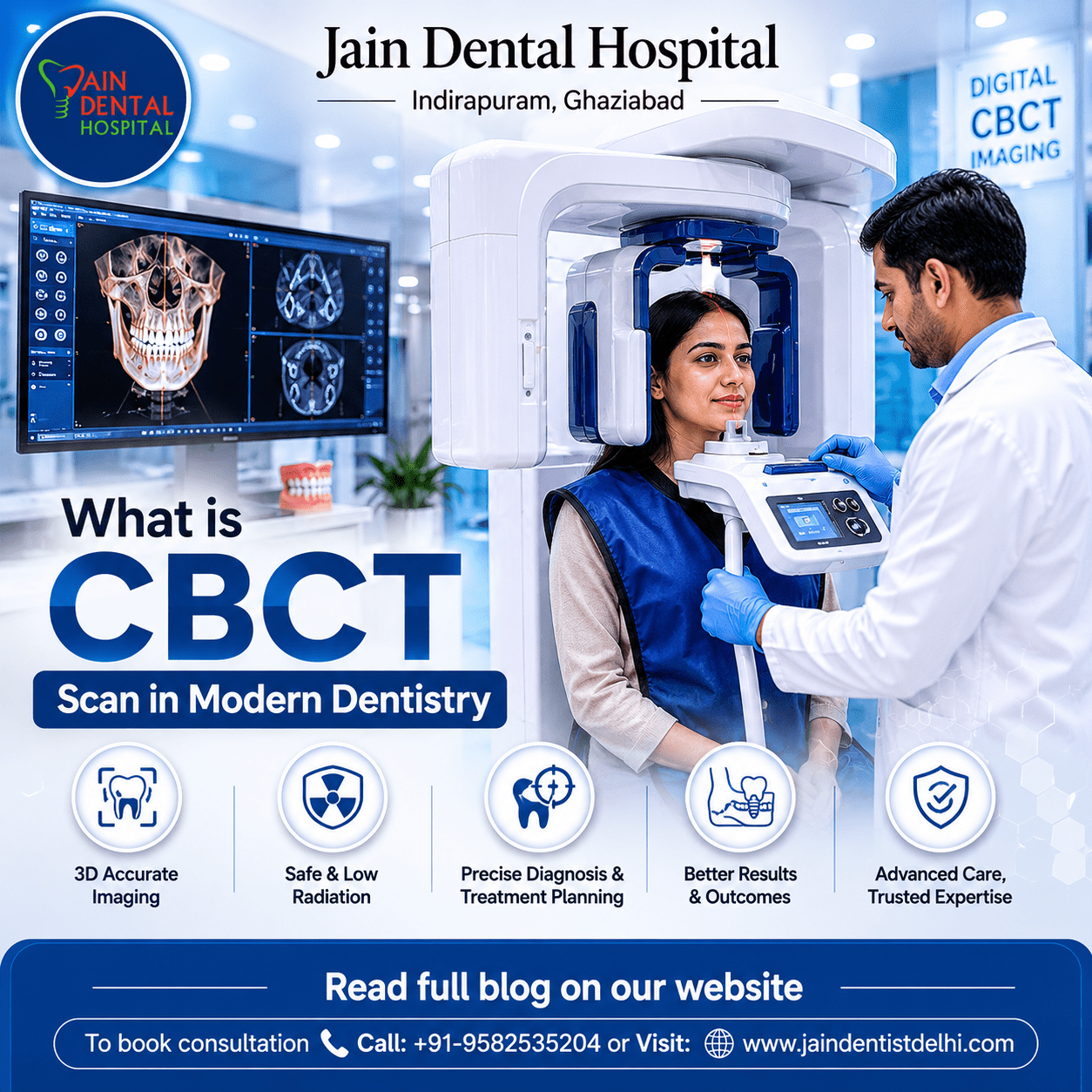
CBCT stands for Cone Beam Computed Tomography. It is a specialized type of X-ray machine used when standard dental or facial X-rays cannot provide enough information. Traditional dental X-rays capture a flat, two-dimensional picture of your teeth. In contrast, a CBCT machine uses a cone-shaped X-ray beam that rotates completely around your head. This process captures hundreds of images from different angles, which a computer then stitches together to create a single, high-resolution 3D model of your mouth.
Because it provides a three-dimensional view, a CBCT scan reveals the exact depth, width, and density of your facial structures. Dentists rely on this detailed view to diagnose problems accurately and plan complex treatments without leaving anything to chance.
What Does a CBCT Scan Show?
A CBCT scan acts as a roadmap of your entire oral anatomy. Knowing what structures the scan reveals helps you understand why your dentist requested it.
- Teeth roots: The scan displays the exact length, shape, and curvature of your tooth roots, which is essential for diagnosing infections deep within the gums.
- Jawbone structure: It measures the exact height and width of your jawbone, allowing your dentist to determine if you have enough bone to support a dental implant.
- Impacted teeth: The 3D image pinpoints teeth that are trapped beneath the gums, such as wisdom teeth, showing their exact angle and position.
- Nerves: The scan maps out major nerve pathways in your lower jaw. Seeing these pathways helps oral surgeons avoid damaging them during extractions or implant placements.
- Sinuses: It displays the exact size and location of your sinus cavities above your upper teeth, which is critical information before placing implants in the upper jaw.
- TMJ (jaw joints): The scan captures the temporomandibular joints, helping dentists diagnose the cause of jaw pain, clicking, or bite misalignment.
- Bone density: The technology measures how dense your jawbone is, which indicates your overall bone health and dictates specific surgical approaches.
Why Is a CBCT Scan Done in Dentistry?
Dentists do not use CBCT scans for routine cleanings or basic cavity checks. They reserve this technology for specific, complex situations where precision is critical. This section outlines the most common treatments that require a 3D dental scan.
CBCT Scan for Dental Implants
Dental implants require an exact fit within your jawbone. A CBCT scan provides the precise measurements needed to ensure the implant process is safe and successful.
- Bone assessment before implant placement: The scan confirms whether your jawbone is thick and dense enough to anchor the titanium implant securely.
- Accurate implant positioning: Your dentist uses the 3D model to virtually place the implant on a computer screen before your actual surgery, ensuring the perfect angle and depth.
- Avoiding nerve damage: By mapping the exact location of the mandibular nerve, the dentist ensures the implant does not intersect with sensitive nerve pathways.
CBCT Scan for Root Canal Treatment
Root canals can be highly complex due to the microscopic size of the root system. A CBCT scan allows the endodontist to navigate these tiny spaces with confidence.
- Detecting hidden canals: Some teeth have extra, curved root canals that do not show up on a standard 2D X-ray. The 3D scan reveals every hidden canal that needs cleaning.
- Identifying infections and fractures: The scan highlights tiny vertical tooth fractures and deep bone infections that traditional imaging often misses.
CBCT Scan for Wisdom Teeth Removal
Extracting wisdom teeth requires careful planning to avoid damaging nearby structures. A CBCT scan gives oral surgeons a clear surgical path.
- Position of impacted wisdom teeth: The image shows exactly how the wisdom tooth is lodged against neighboring teeth or buried in the jawbone.
- Relation to nearby nerves: The roots of lower wisdom teeth often sit very close to the main jaw nerve. The 3D scan shows the exact distance between the root and the nerve, reducing the risk of temporary or permanent numbness after surgery.
CBCT Scan in Orthodontics
Orthodontic treatment involves moving teeth through bone. A CBCT scan gives orthodontists the complete structural picture before they apply pressure to your teeth.
- Braces and aligner treatment planning: The scan helps the orthodontist see the roots of the teeth and the surrounding bone, ensuring that the teeth can move safely into their new positions.
- Jaw alignment evaluation: It reveals severe skeletal imbalances, helping the doctor decide if corrective jaw surgery is needed alongside braces.
CBCT Scan for TMJ Disorders
Jaw pain often originates from issues inside the jaw joint itself. A CBCT scan helps diagnose the root cause of temporomandibular joint (TMJ) disorders.
- Evaluating jaw joints and bite issues: The scan reveals arthritis, wear and tear, or structural deformities within the joint, guiding the dentist toward the proper therapy or splint treatment.
CBCT Scan for Oral Surgery
When dealing with abnormal growths or severe trauma, oral surgeons need a complete view of the pathology. A CBCT scan is a vital tool for advanced surgical planning.
- Cysts: The scan shows the exact size of a fluid-filled cyst and how much surrounding bone it has damaged.
- Tumors: It helps surgeons evaluate the borders of benign or malignant tumors within the jaw region.
- Bone abnormalities: The 3D image highlights areas of bone loss or unusual bone growths that require surgical intervention.
How Does a Dental CBCT Scan Work?
The idea of standing inside a large medical scanner can feel intimidating. However, the CBCT process is incredibly simple and entirely non-invasive. This section explains exactly how the machine captures your dental images.
The process begins when you step up to the CBCT machine. The dental technician will ask you to place your chin on a small rest to keep your head perfectly still. You will bite down gently on a sterile plastic mouthpiece to separate your upper and lower teeth slightly. Once you are positioned correctly, the machine’s arm rotates 360 degrees around your head. As it moves, the cone-shaped X-ray beam captures hundreds of images. The machine sends these images to a computer, which instantly compiles them into a digital 3D model that your dentist can view and manipulate on a monitor.
How Long Does a CBCT Scan Take?
You will not spend much time in the scanning room. The actual rotation of the scanner takes between 10 to 40 seconds. The entire appointment, including positioning and saving the digital file, generally takes less than ten minutes.
How to Prepare for a CBCT Scan?
You do not need to alter your daily routine before the scan. You will simply need to remove any metal objects from your head and neck area, such as glasses, earrings, necklaces, hearing aids, and removable dental appliances. Metal can interfere with the X-ray beam and distort the final image.
Benefits of CBCT Scan in Dentistry
Dentists invest in CBCT technology because it directly improves the quality of patient care. This section highlights the core benefits you receive when your dentist uses 3D imaging.
The primary benefit of a CBCT scan is the elimination of guesswork. By providing highly accurate 3D imaging, your dentist can create a better treatment plan. Improved diagnosis means they catch problems early, before they become painful or expensive. For you, this translates to safer surgeries, more precise dental implants, and faster, more predictable healing outcomes.
Advantages of CBCT Over Traditional Dental X-Rays
While standard X-rays are excellent for routine cavity checks, they have limits. Here is how CBCT technology improves upon older methods.
- More detailed imaging: CBCT shows soft tissues, nerve pathways, and bone thickness simultaneously, whereas traditional X-rays only show hard tissues like teeth and bone in a flat view.
- Better visibility: Because it is a 3D model, the dentist can rotate the image on a screen to look behind teeth and structures that overlap in a standard 2D X-ray.
- Precise measurements: CBCT software provides exact millimeter measurements of your anatomy, which is a strict requirement for safely placing dental implants.
Is a CBCT Scan Safe?
Any medical procedure involving radiation naturally raises safety concerns. This section explains the radiation exposure involved in a CBCT scan and the protocols dentists use to keep you safe.
A dental CBCT scan is very safe. While it does use ionizing radiation, the cone-shaped beam focuses only on the specific area of your mouth that requires examination. This targeted approach significantly reduces the amount of scatter radiation compared to traditional medical CT scans used in hospitals. Dentists follow the ALARA principle—As Low As Reasonably Achievable—meaning they only request a CBCT scan when the diagnostic benefits clearly outweigh the minimal risks of radiation exposure.
CBCT Scan Radiation Dose
The radiation dose from a dental CBCT scan is quite low. It produces roughly 10 to 70 microsieverts of radiation, depending on the machine and the scan size. To put this in perspective, you are exposed to about 8 microsieverts of background radiation just by living on Earth for one day.
Is CBCT Safe for Children?
CBCT scans are safe for children, but dentists exercise extra caution. Because children are more sensitive to radiation, pediatric dentists only use CBCT when absolutely necessary, such as for evaluating severe orthodontic issues or impacted teeth. When they do, they use the lowest radiation setting possible.
Who Should Avoid CBCT Scans?
Pregnant women should generally avoid elective CBCT scans. While the radiation is focused on the head and neck, dentists prefer to postpone non-emergency X-rays until after childbirth to eliminate any potential risk to the developing baby. Always inform your dentist if you are or might be pregnant.
What Happens During a CBCT Scan?
Knowing what to expect during your appointment helps you feel calm and prepared. This section walks you through the physical experience of getting a CBCT scan.
The procedure is entirely non-invasive and painless. Depending on the machine model at your clinic, you will either stand up or sit in a chair. The technician will adjust the machine to your height and guide your face into the proper position. The most important thing you must do is remain completely still while the scanner rotates around your head. Even small movements can blur the image, which might require you to retake the scan.
Does a CBCT Scan Hurt?
A CBCT scan does not hurt at all. The machine never touches you, aside from the chin rest and the small plastic bite guide. There are no injections, no loud noises, and no enclosed spaces like an MRI machine.
Can You Eat Before a CBCT Scan?
Yes, you can eat and drink normally before your appointment. The scan only takes images of your hard and soft tissues. Digestion does not affect the imaging process, so fasting is completely unnecessary.
CBCT Scan vs Dental X-Ray – What’s the Difference?
To help you understand why your dentist chose a CBCT scan over a standard X-ray, this section provides a clear comparison of the two technologies.
| Feature | CBCT Scan | Dental X-Ray |
| Imaging Type | 3D (Three-dimensional) | 2D (Two-dimensional) |
| Detail Level | High (Shows bone, nerves, and soft tissue) | Basic (Shows teeth and general bone height) |
| Best For | Implants, oral surgery, complex root canals | Routine checkups, detecting simple cavities |
| Radiation | Moderate (Higher than 2D, much lower than Medical CT) | Low |
| Accuracy | Very high (Exact 1:1 measurements) | Limited (Subject to overlapping and distortion) |
Cost of CBCT Scan in Dentistry
Understanding the financial aspect of your treatment is a vital part of your healthcare journey. This section outlines the typical costs associated with a CBCT scan and what factors influence that price.
The average CBCT scan cost in Delhi/NCR in India ranges from ₹1,500 to ₹4,000. This price can vary based on several specific factors.
- Scan area: A scan of a single tooth or one quadrant of your mouth costs less than a full-mouth (full-arch) scan.
- Clinic location: Specialized diagnostic centers or high-end dental clinics in premium urban areas typically charge more for their imaging services.
- Technology used: Clinics using the newest, lowest-radiation machines with advanced diagnostic software may have slightly higher fees.
Is CBCT Covered by Insurance?
Dental insurance coverage for CBCT scans varies widely. Many insurance plans consider CBCT a specialized diagnostic procedure. If the scan is medically necessary—such as for diagnosing a cyst, tumor, or severe facial trauma—your medical or dental insurance is more likely to cover it. However, if the scan is used to plan for dental implants, which insurance often categorizes as cosmetic, you may have to pay out of pocket. Always check with your insurance provider beforehand.
Is a CBCT Scan Worth the Cost?
Yes, a CBCT scan is a valuable investment in your oral health. The precise data it provides prevents surgical complications, helps you avoid nerve damage, and ensures that expensive treatments like dental implants are placed correctly the first time. Spending a small amount on accurate imaging can save you from costly retreatment procedures in the future.
When Do Dentists Recommend a CBCT Scan?
Dentists follow strict guidelines regarding when to use advanced imaging. You should expect a recommendation for a CBCT scan in the following scenarios:
- Before placing dental implants to evaluate bone volume.
- When diagnosing complex root canals or unexplained tooth pain.
- Prior to extracting impacted wisdom teeth near major nerves.
- To evaluate the jaw joint if you suffer from severe TMJ pain.
- To assess severe bone loss caused by advanced periodontal (gum) disease.
- During complex orthodontic treatment planning.
Risks and Limitations of CBCT Scans
While highly beneficial, no medical technology is perfect. You should be aware of the minor risks and limitations associated with CBCT imaging.
- Radiation exposure: Though low, there is still radiation exposure. Dentists only use CBCT when traditional X-rays cannot provide the necessary data.
- Not always needed for routine cases: CBCT is unnecessary for diagnosing simple cavities or performing routine dental cleanings.
- Cost considerations: It adds an extra expense to your dental treatment plan that may not be covered by insurance.
Image distortions due to metal restorations: Metal crowns, amalgam fillings, or braces can cause “scatter” or “artifacts” on the scan, creating bright streaks that can obscure nearby anatomical details.
Frequently Asked Questions (FAQ) About CBCT Scan in Dentistry
Patients naturally have questions when introduced to new dental technology. This section provides direct answers to the most common queries regarding CBCT scans.
Is a CBCT scan painful?
No, a CBCT scan is completely painless. The machine simply rotates around your head to capture images without touching you.
How much radiation does a CBCT scan have?
A dental CBCT scan exposes you to approximately 10 to 70 microsieverts of radiation. This is significantly less than a traditional medical CT scan and is equivalent to the background radiation you absorb over a few days of normal life.
How long does a dental CBCT scan take?
The actual scanning process takes less than one minute, usually between 10 and 40 seconds. Your total time in the imaging room will be about 10 minutes.
Can pregnant women get a CBCT scan?
Pregnant women should generally avoid CBCT scans unless it is a strict dental emergency. You should always inform your dentist if you are pregnant so they can adjust your treatment plan accordingly.
Do I need fasting before a CBCT scan?
No, you do not need to fast. You can eat and drink normally prior to your appointment because digestion does not affect the imaging of your jaw and teeth.
Is CBCT better than a dental X-ray?
CBCT is better for complex procedures because it provides a highly detailed 3D image. However, standard dental X-rays remain the best and safest option for routine checkups and finding simple cavities.
Can CBCT detect infection?
Yes, a CBCT scan is excellent at detecting infections deep within the jawbone or at the tip of a tooth root that a standard 2D X-ray might miss.
What is the cost of CBCT scan in Delhi/NCR in India?
The cost of a CBCT scan in the Delhi/NCR region typically ranges from ₹1,500 to ₹4,000, depending on the area being scanned and the specific diagnostic center.
Conclusion: Securing Your Dental Health with Accurate Diagnosis
A CBCT scan is a cornerstone of modern, evidence-based dentistry. By providing highly accurate 3D views of your oral anatomy, this technology allows your dentist to see exactly what is happening beneath the surface. This advanced planning reduces surgical risks, improves diagnostic accuracy, and ensures your treatment is customized to your unique jaw structure.
You deserve dental care that prioritizes your safety and long-term comfort. If your dentist recommends a CBCT scan, you can trust that it is an essential step toward a predictable, successful outcome. Take the guesswork out of your dental health and ensure your next procedure is planned with precision.
Schedule Your Consultation Today
Understand Your Dental Condition with Advanced CBCT Imaging
Now that you understand what a CBCT scan in dentistry is — from its role in accurate diagnosis to its importance in dental implants, root canals, wisdom tooth surgery, and orthodontic treatment planning — the next step is getting the right evaluation from experienced dental professionals using advanced diagnostic technology.
At Jain Dental Hospital, Dr. Arpan Pavaiya Jain and Dr. Rashi Agarwal Jain use modern CBCT imaging to provide precise diagnosis and personalized treatment planning for safer, more predictable dental care. Whether you need a detailed assessment before a dental procedure or expert guidance regarding your oral health concerns, our team is committed to delivering accurate, patient-focused dental solutions.
📞 Call: +91-9582535204
🌐 Visit: www.jaindentistdelhi.com
Medical Advice Disclaimer:
The information provided in this article is for general educational and informational purposes only and is not intended as professional medical or dental advice, diagnosis, or treatment. While we strive for accuracy, every patient’s dental anatomy and clinical needs are unique. Always seek the advice of your dentist or another qualified healthcare provider with any questions you may have regarding a medical condition. Never disregard professional medical advice or delay seeking it because of something you have read on this website

Dr. Arpan Pavaiya Jain, Director of Jain Dental Hospital, Indirapuram, Ghaziabad is a renowned Prosthodontist and Implantologist with over 20 years of expertise in advanced dentistry. A graduate of the prestigious King George’s Medical College Lucknow, he has performed more than 20,000 successful dental implant procedures. Dr. Jain leads a team of skilled professionals, offering state-of-the-art treatments in dental implants, clear aligners, cosmetic dentistry, orthodontics, and more. Known for his personalized care and commitment to excellence, he has earned a reputation as a trusted dental expert in Indirapuram, Ghaziabad.