Clear Aligners for Crowded Teeth: Mild to Severe
- Mild and moderate crowding: Clear aligners for crowded teeth often work well here.
- Severe crowding: This is where aligners have the most limits. Braces, or braces first and then aligners, may suit it better.
- Making space: Many crowded teeth can be straightened without removing a tooth, by polishing a little between some teeth (IPR) and slightly widening the arch. In some moderate cases, a tooth may need to be removed.
- Crowded lower teeth: In some mild cases, only the lower teeth may need aligners. In many cases, both the upper and lower teeth are treated so the bite meets in the right place.
- What shapes your plan: Your bite, your gums and bone, and wearing aligners 20 to 22 hours a day.
- Your first step: Only an exam with X-rays and a 3D scan can show your level of crowding. Your trays are made only after you agree to the plan.
Want to know which plan suits your teeth? Book a check-up and 3D scan at Jain Dental Clinic, Indirapuram.
Aligners can straighten crowded teeth in many mild and moderate cases, often without removing a tooth. Severe crowding is harder, and braces, or braces first and then aligners, may suit it better. Which plan suits you depends on how much space is missing, your bite and the health of your gums. Only an exam with X-rays and a 3D scan can tell.
Maybe your front teeth overlap a little, or one tooth sits slightly behind the others. You may be wondering if aligners can straighten them without metal braces showing at work or in photos. It’s a question many people with crowded teeth ask before they book a check-up.
The short answer is yes, in many cases. Clear aligners for crowded teeth often work well when the crowding is mild or moderate. Aligners have more limits when crowding is severe, and braces may suit it better. So the honest answer depends on how crowded your teeth are and how your bite fits together.
Crowding happens when your jaw doesn’t have enough room for all your teeth to line up neatly. You can read more about what causes crowded teeth in our separate guide. Here, you’ll get an honest picture of what aligners can and can’t do. You’ll learn how mild, moderate and severe crowding differ, how dentists make space, and when braces may suit you better. First, let’s look at what decides whether aligners can fix your crowding.
Can Aligners Fix Crowding?
For many people, yes. Aligners straighten crowded teeth by moving them a small step at a time, with each new tray taking them a little further. How well they work for you depends on four things your dentist checks before making any plan.
- How much space is missing. The more your teeth overlap or are rotated (twisted), the more room they need to line up in a neat row. Your dentist checks this on a 3D scan, which is a digital model of your teeth.
- How your teeth bite together. Your bite is the way your upper and lower teeth meet when you close your mouth. If your bite is also off, the plan has to correct it as well as the crowding.
- The health of your gums and bone. Teeth move through the bone that holds them, so your gums and bone need to be healthy before treatment starts. X-rays show the roots and bone that you can’t see in the mirror.
- How well you wear your aligners. Aligners only move your teeth while they’re in your mouth, so you need to wear them 20 to 22 hours a day. If that isn’t practical for your routine, braces may suit you better.
Together, these four points decide whether your crowding is a good match for aligners. If you’re still unsure about aligners in general, read our guide on whether aligners suit your teeth.
Can Invisalign Fix Crowded Bottom Teeth?
In many cases, yes. Crowding is common in the lower front teeth, and aligners for lower teeth work the same way as they do on the upper teeth. Invisalign is one brand of clear aligner, and the same is true of the other brands.
The bigger question is often whether only the lower teeth can be treated. In some mild cases, only the lower teeth may need aligners. In many cases, though, straightening just the lower teeth would leave the bite meeting in the wrong place, so both the upper and lower teeth are treated.
Your arch is the curved row of teeth in each jaw. When more space is needed, the upper arch is usually widened first, and the lower teeth are then lined up to fit it. Your dentist can tell which plan suits you after checking how your upper and lower teeth bite together.
Mild, Moderate or Severe: What Clear Aligners for Crowded Teeth Can Do
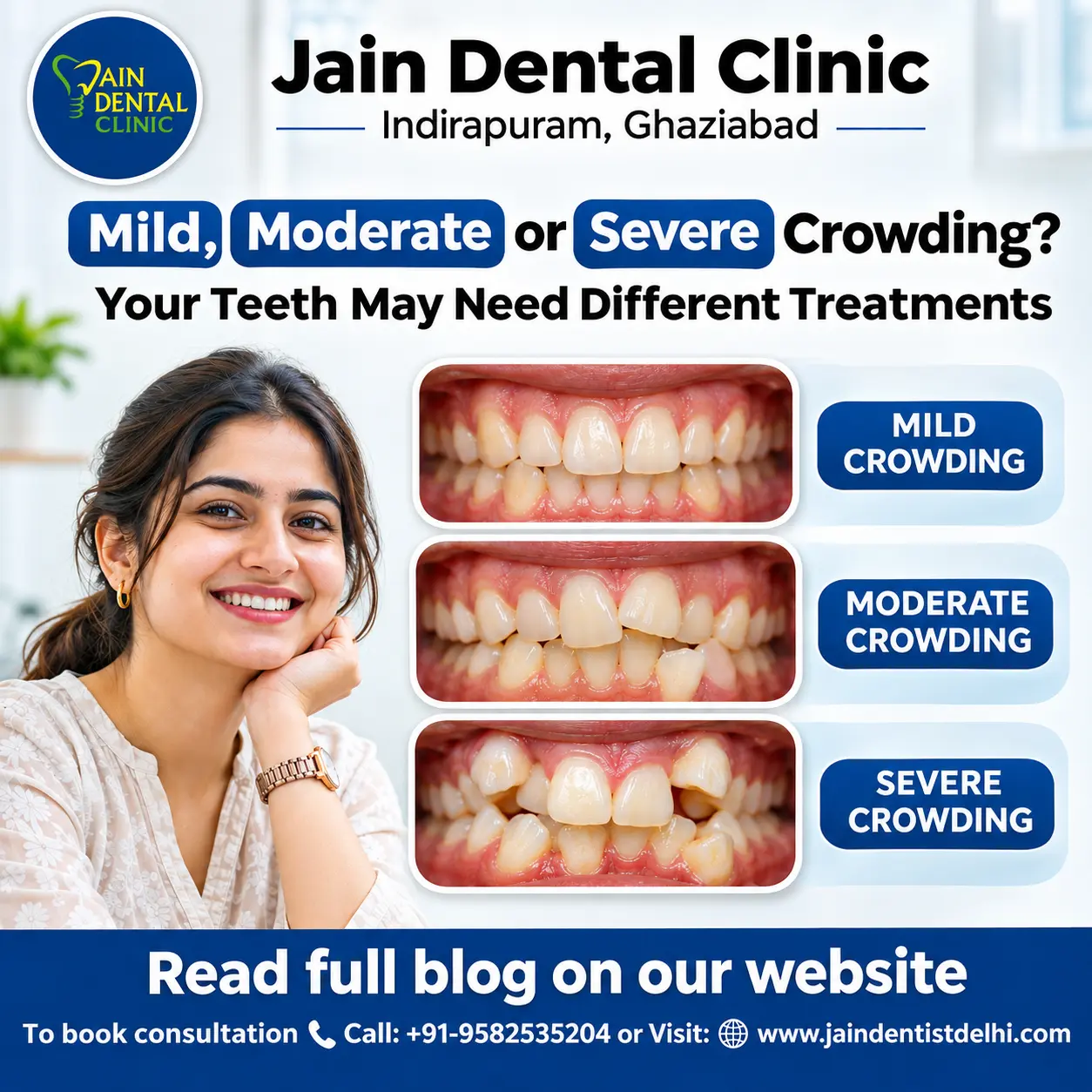
Dentists usually group crowding into three levels: mild, moderate and severe. The level matters because it changes what clear aligners for crowded teeth can do and how your dentist makes space. The table below gives a simple guide to each one.
| Level | What you may notice | What may be planned |
|---|---|---|
| Mild | One or two teeth overlap slightly or are a little rotated. Your smile still looks mostly even. | Aligners often suit. Any space needed is made by polishing a little between some teeth (IPR) and slightly widening the arch. |
| Moderate | Several teeth overlap, some are clearly rotated, or a tooth sits a little in front of or behind the others. | Aligners often still suit, using the same two ways to make space. In some moderate cases, a tooth may need to be removed to make space. Either aligners or braces can then follow, depending on the case. |
| Severe | Teeth overlap a lot, some sit well out of line, or a tooth has no room to come through properly. | Aligners alone may not be enough. Braces, or braces first and then aligners, may be planned. |
This table is only a rough guide. It can’t tell you which level you have. Your dentist measures how much space is missing on your 3D scan. Two people whose teeth look alike may still need quite different plans. That’s why, at our clinic, treatment for overlapping teeth starts with a check-up, X-rays and a 3D scan. Severe crowding needs a closer look, so it has its own section further down.
Can Crowded Teeth Be Fixed Without Extraction?
Yes, many crowded teeth can be straightened without extraction, which means removing a tooth. When no tooth is removed, your dentist makes space by polishing between some teeth and by slightly widening the arch. Knowing how each one works can ease the worry many people have about losing a tooth.
Polishing Between Some Teeth (IPR)
Your dentist gently polishes a very small amount of enamel from between some teeth. Enamel is the hard outer layer of a tooth. Dentists call this interproximal reduction, or IPR. The tiny gaps it leaves give crowded teeth room to slide into line. If you’re wondering whether IPR is safe, you’ll find a short answer in the questions at the end.
Slightly Widening the Arch
Sometimes the arch is a little too narrow for all your teeth to fit. Aligners can gently guide the teeth outward to make the curve slightly wider. A wider curve gives the crowded front teeth more room. Teeth can only move so far within the bone that holds them, so widening adds a modest amount of space, not a large one.
When a Tooth May Need to Be Removed
In some moderate cases, a tooth may need to be removed to make space. This may be suggested when IPR and widening still can’t make enough room for the teeth to line up well. Either aligners or braces can then follow, depending on the case.
If you’ve been told you need a tooth removed, it’s fair to ask your dentist why. You can also ask what other options there are and how each one would affect your bite.
Can Invisalign and Other Aligners Fix Severe Crowding?
Sometimes, but severe crowding is where aligners have the most limits. A research team led by Yassir looked at many earlier reviews in 2022. They found that aligners work well in mild to moderate cases, but braces gave better results in severe ones.
A 2019 review by Ke and colleagues found that braces did better at some kinds of tooth movement. These included how the back teeth meet and keeping the roots at the right angle. Braces also held results in place better, but the authors said there are not many strong studies.
So can Invisalign fix severe crowding? The honest answer is that it depends on your case. At our clinic, Invisalign and Smile Pro (the two aligner brands we use) work almost the same way, so the brand you pick doesn’t change this.
When Braces May Suit Your Crowding Better
Your dentist may plan braces in three cases.
- Severe crowding. When teeth are far out of line, braces give your dentist more control over big moves.
- A severe bite problem. This is when your upper and lower teeth don’t meet the way they should. Dentists call this malocclusion.
- When aligners can’t be worn enough. Aligners need to be worn 20 to 22 hours a day. If that’s hard for you, braces keep working because they’re fixed to the teeth.
This doesn’t mean braces are right for everyone. Each one suits different cases, and you can read more about how aligners compare with braces.
A Two-Step Plan: Braces First, Then Aligners
In some severe cases, braces come first and aligners finish the treatment. This way, braces can handle the larger movements, and aligners take over for the final steps. Your dentist can tell you whether this kind of plan suits your teeth.
How Your Crowding Is Checked Before a Plan Is Made
Only a proper exam can show which level of crowding you have and what may work for it. At our clinic, the checks follow a clear order, and nothing is made until you agree to the plan.
- Check-up and X-rays. Your dentist looks at your teeth, gums and bite. An OPG X-ray, one wide picture of all your teeth and both jaws, shows the roots and bone.
- 3D scan. A small scanner builds a digital 3D model of your teeth.
- Your 3D plan. A computer plan maps each tooth’s movement and shows how many trays you need.
- Your decision. Your trays are made only after you agree to the plan.
- Trays and check-ups. Each tray is usually worn for about 2 weeks, based on the computer analysis of your plan. Some cases need a few more days, and this varies from person to person. You’ll also have check-ups every 6 to 8 weeks.
How long treatment takes depends on how far your teeth need to move, as the US FDA’s guide to aligners also says. Our guide on how long aligner treatment usually takes explains this in more detail.
The total cost depends on the brand you choose, the number of trays in your plan, any extra trays if they’re needed, and your retainers afterwards. Our guide on what decides the cost of aligners explains each one.
Frequently Asked Questions (FAQ) About Clear Aligners for Crowded Teeth: Mild to Severe
Here are short answers to questions people often ask about aligners and crowding. Each one points you to more detail where it helps.
Can Adults Fix Crowded Teeth With Aligners?
Yes, many adults straighten crowded teeth with aligners. Age on its own isn’t the main limit. What matters more is how crowded your teeth are and whether your gums and bone are healthy. That’s why your dentist checks your gums and takes X-rays before planning anything.
Can Aligners Fix My Teenager’s Crowded Teeth?
Often, yes, if the crowding suits aligners. At our clinic, aligners are used for teens, usually from 13 to 15 years of age. Both brands offer a teen option with wear indicators, which help show whether the aligners are being worn enough. Read more in our guide on aligners for teenagers.
Is IPR Safe for My Teeth?
Research so far is reassuring: studies have not found more cavities on teeth that had IPR. Only a very small amount of enamel is polished away, and only between the teeth that need space. You can read more in our guide on how safe aligner treatment is.
Will I Need Attachments on My Teeth?
Probably. At our clinic, attachments are used in most cases. Attachments are small, tooth-coloured bumps fixed to some teeth. They give the trays something to grip, so the trays can move teeth more precisely. This extra grip often helps with rotated teeth, which are a big part of crowding.
Will I Need Extra Aligners Near the End?
Sometimes. A few extra trays are sometimes needed near the end to fine-tune the position of some teeth. This doesn’t mean the treatment failed, because teeth may not move exactly as planned. Extra trays add some time near the end, and your dentist will tell you how much.
Will My Teeth Crowd Again After Treatment?
They can, if nothing holds them in place. Teeth tend to drift back toward their old positions after treatment. A retainer, either a thin fixed wire or a clear removable one, helps keep them straight. Your dentist will tell you how to wear it. Read more about wearing a retainer afterwards.
Conclusion: What Clear Aligners for Crowded Teeth Can Do for You
Clear aligners for crowded teeth suit many mild and moderate cases. When no tooth is removed, space comes from polishing a little between some teeth and slightly widening the arch. In some moderate cases, a tooth may need to be removed to make room.
Severe crowding is different. Braces, or braces first and then aligners, may suit it better. Your bite, the health of your gums and bone, and how well you can wear aligners all shape the plan too.
A guide like this can only point you in the right direction. An exam with X-rays and a 3D scan shows which level of crowding you have and what may work for it. Once your dentist has checked your teeth, you can weigh your options with a clear picture of what aligners can and can’t do for you.
Schedule Your Consultation Today
Find Out Which Plan Suits Your Crowded Teeth
Not sure if your crowding is mild, moderate or severe? A check-up and 3D scan show how much space your teeth need, and you find out before you decide anything.
At Jain Dental Clinic in Indirapuram, Ghaziabad, Dr. Arpan Pavaiya Jain and Dr. Rashi Agrawal Jain can check your teeth, gums, bite and jaw joints. They take a full-mouth X-ray and a 3D scan. A 3D preview then shows how your teeth are planned to move. Before anything is made for you, you will know which plan suits your crowding and how many trays you would need.
Perhaps your front teeth overlap and it bothers you in photos or at work. Perhaps you have been told a tooth must come out and you would like a second view. You may have had braces years ago and noticed your teeth crowding again. Or you may be a parent planning around your teenager’s school years. Whatever your reason, our team can explain your options in plain words. Depending on your needs, the next step may be clear aligners, braces, braces first and then aligners, or treating your gums or a cavity first.
The clinic is an authorized Invisalign® provider and also offers Smile Pro aligners and braces. So your plan is built around your teeth, not around one product.
📞 Call: +91-9582535204 🌐 Visit: www.jaindentistdelhi.com
Medical Advice Disclaimer:
The information provided in this article is for general educational and informational purposes only and is not intended as professional medical or dental advice, diagnosis, or treatment. While we strive for accuracy, every patient’s dental anatomy and clinical needs are unique. Always seek the advice of your dentist or another qualified healthcare provider with any questions you may have regarding a medical condition. Never disregard professional medical advice or delay seeking it because of something you have read on this website

Dr (Prof.) Arpan Pavaiya Jain is an Oral & Maxillofacial Prosthodontist and Implantologist and the director of Jain Dental Clinic, Indirapuram. He completed his BDS and MDS at King George’s Medical College, Lucknow, and has over 25 years of clinical experience. He is an Invisalign Diamond Provider.