What Is Malocclusion? Types, Signs and Why Your Bite Is Off
- Malocclusion is a misaligned bite in which the upper and lower teeth or jaws do not meet as they normally should. It can include overbites, overjets, underbites, crossbites, open bites, crowding, and spacing.
- Signs of malocclusion can include teeth that do not meet properly, visible crowding or gaps, difficulty chewing, frequent cheek or tongue biting, and uneven tooth wear. Some people have no noticeable symptoms.
- Treatment is not always necessary. When correction is needed, options may include braces, clear aligners, orthodontic appliances, or other treatment based on the type and severity of the bite problem.
- If your bite feels off or has changed, consider a professional evaluation. A dentist or orthodontist can assess your bite and explain whether treatment may be helpful. Schedule a consultation at Jain Dental Clinic if you are concerned about your bite, tooth alignment, or chewing.
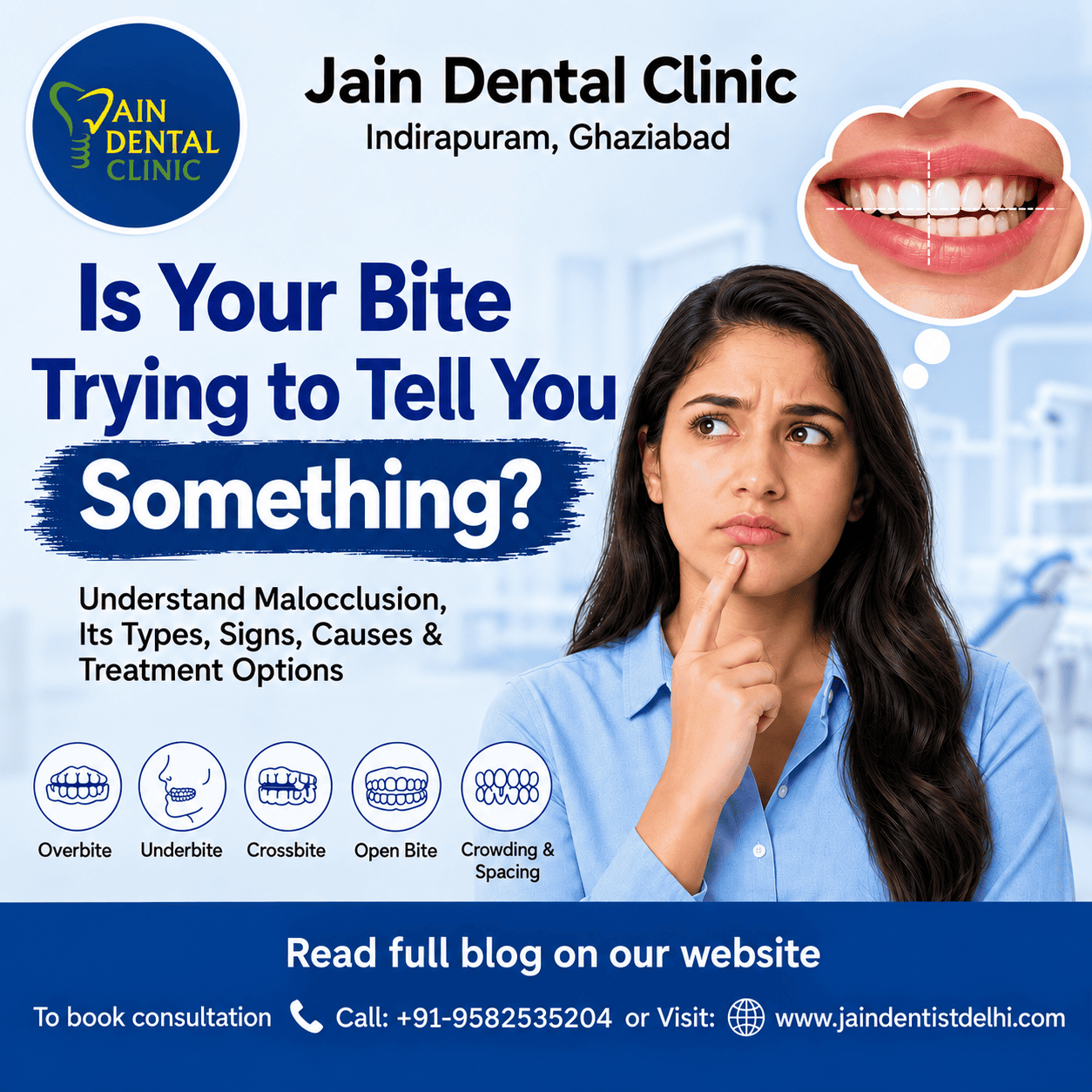
Explore the complete guide to understand the different types of malocclusion, what can cause them, and how a professional can assess your bite.
Does your bite feel uneven, or do your upper and lower teeth seem unable to meet properly? You may be noticing signs of malocclusion, a misaligned bite that can involve your teeth, jaws, or both. This guide explains what is malocclusion, the different types, common symptoms, and causes of malocclusion, including overbite, underbite, crossbite, open bite, crowding, and spacing. It also explains how dentists and orthodontists assess bite problems and when treatment may be considered. If you live in Ghaziabad or Delhi NCR, understanding these signs can help you decide when a professional dental assessment may be useful. Read the full post to learn how malocclusion can affect your bite, oral health, and treatment choices, and understand when professional guidance may be appropriate.
Do your upper and lower teeth feel like they do not quite fit together when you bite down? Maybe you have noticed that your front teeth overlap more than they should, that certain teeth never seem to touch, or that chewing feels uneven on one side. These experiences are more common than most people realize — and they often point to a condition called malocclusion.
Malocclusion is the dental term for a misaligned bite. It describes the relationship between the upper and lower teeth when the mouth closes, and it covers far more than simply having crooked teeth. You can have teeth that look relatively straight from the front and still have a significant bite problem. You can also have visibly crowded teeth without any meaningful functional issue. The distinction matters — and understanding it is the first step toward knowing whether your bite deserves professional attention.
This article explains what malocclusion means, what a normal bite looks like, the different types and how to recognize them, what causes them, and how dentists and orthodontists evaluate and treat the condition. By the end, you will have the information you need to decide whether a professional assessment makes sense for you.
What Is Malocclusion?
Malocclusion is a broad orthodontic concept, not simply another word for crooked teeth. This section explains what it means, what a normal bite looks like, and why the two are not the same thing.
What does “malocclusion” mean?
The word comes from Latin: “mal” meaning bad, and “occlusio” referring to the way teeth come together. Occlusion, in dental terms, simply means how the upper and lower teeth meet. When that meeting is off — when the teeth or jaws do not align the way they should — the result is malocclusion.
A normal bite involves a specific, predictable relationship between teeth. The upper teeth sit slightly in front of and over the lower teeth. The pointed ridges of the upper back teeth fit neatly into the grooves of the lower back teeth. When that relationship is disrupted, either by the position of individual teeth or by the position of the jaws themselves, a malocclusion exists.
What does a normal bite look like?
A well-aligned bite has a few key characteristics. The upper front teeth overlap slightly in front of the lower front teeth — not excessively, just enough to allow comfortable contact. The back teeth interlock cleanly, with the upper molars sitting slightly outside the lower molars. Biting and chewing feel comfortable, without strain or unevenness on one side.
You do not need a perfect bite for your teeth to function well. Slight variations are common and often clinically insignificant. The concern arises when the bite relationship departs enough from normal to affect function, oral hygiene, or the long-term health of the teeth and supporting structures.
Is malocclusion the same as crooked teeth?
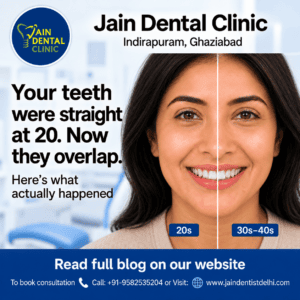
Not exactly — and this is a distinction worth understanding clearly. Crooked teeth refer to the position of individual teeth: a tooth that is rotated, tilted, or displaced from its ideal location. Malocclusion refers to the broader relationship between the upper and lower dental arches, which can involve individual tooth positions, the overall bite, the jaws, or a combination of all three.
A person can have teeth that look straight but still have a deep overbite or a crossbite. Another person can have crowded, overlapping teeth without any significant bite discrepancy. Professional evaluation is the only way to assess which — if either — applies to you.
What Are the Different Types of Malocclusion?
Malocclusion comes in several forms, each describing a different way the bite can be off. Some of these are commonly searched terms — overbite, underbite, crossbite — while others are clinical classifications that dentists use to categorize the overall bite relationship. Both approaches are covered here.
1 Overbite
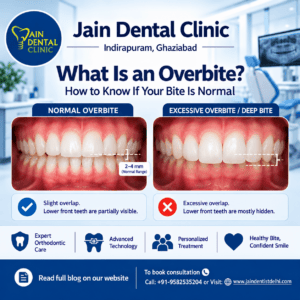
An overbite (also called a deep bite) occurs when the upper front teeth overlap the lower front teeth vertically by more than is considered normal. In a well-aligned bite, the upper front teeth cover roughly 10–20% of the lower front teeth. In a pronounced overbite, the upper teeth may cover 50% or more of the lower teeth — and in severe cases, the lower teeth may bite into the palate (the roof of the mouth) behind the upper teeth.
A mild overbite is one of the most common bite patterns and often causes no problems at all. A deep overbite can place stress on the lower front teeth, accelerate enamel wear, and sometimes affect jaw comfort.
2 Overjet
Overjet describes how far the upper front teeth project horizontally beyond the lower front teeth. This is not the same as an overbite, which measures vertical overlap. When the overjet is significant, the upper teeth protrude noticeably, which many people informally refer to as “buck teeth” — though that phrase can be misleading, since overjet can result from the position of the teeth, the position of the jaws, or both.
The American Board of Orthodontics defines an overjet of 3.1mm to 9mm as clinically notable. A large overjet can make the upper front teeth more vulnerable to injury, particularly in contact sports or from accidental impact.
3 Underbite
An underbite occurs when the lower front teeth extend in front of the upper front teeth when biting down. This is the opposite of the expected relationship. In some cases, the underbite is caused primarily by the position of individual teeth. In others, the lower jaw itself is positioned further forward than the upper jaw — a skeletal difference that can affect the overall profile of the face.
Underbites are less common than overbites and tend to be more complex to treat, particularly when the jaw relationship is involved. Difficulty chewing and changes to how the lower jaw closes can both arise in more pronounced cases.
4 Crossbite
A crossbite occurs when one or more upper teeth sit inside the lower teeth rather than outside them, as they should. This can affect the front teeth (an anterior crossbite), the back teeth (a posterior crossbite), or both.
In a normal bite, the upper teeth sit slightly outside the lower teeth, like a lid sitting over a box. A crossbite reverses this relationship for the affected teeth. The result is uneven bite forces — certain teeth bear pressure from an angle they were not designed to handle, which over time can contribute to tooth wear, jaw strain, and asymmetrical jaw movement.
5 Open Bite
An open bite means that certain upper and lower teeth do not make contact when the mouth is closed. The most common pattern is an anterior open bite, where the front teeth fail to touch even when the back teeth are fully together, leaving a visible gap.
Open bites are often associated with prolonged thumb-sucking or pacifier use in early childhood, as well as a habit called tongue thrusting (where the tongue presses forward against the teeth during swallowing or at rest). Biting into foods can be challenging with an anterior open bite, and in some cases, speech can be affected.
6 Crowding
Crowding occurs when there is not enough space in the jaw for all the teeth to fit in their correct positions. The result is teeth that overlap, rotate, tilt, or push in front of each other to compete for available space.
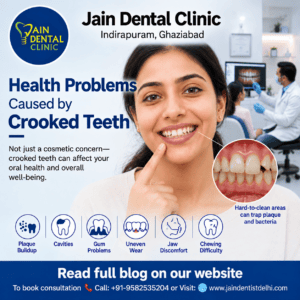
Crowded teeth are harder to clean effectively. Floss struggles to get between overlapping teeth, and a toothbrush cannot always reach the surfaces that face each other. Over time, this can make it more difficult to maintain good oral hygiene — not because a person is brushing incorrectly, but because the tooth positions make thorough cleaning genuinely more challenging.
7 Spacing
Spacing refers to excessive gaps between teeth. This can occur when teeth are smaller than the jaw that holds them, when teeth are missing and neighboring teeth have not fully drifted to close the gap, or when the jaw itself is larger than the teeth it contains.
Spacing is the opposite of crowding but can also raise practical concerns. Food can become trapped in gaps, and missing teeth that have not been replaced may lead to gradual shifting in surrounding teeth.
8 Class I, Class II, and Class III Malocclusion
Orthodontists also use a clinical classification system developed by Edward Angle in 1899 — still the standard framework in practice today — to describe the overall relationship between the upper and lower arches based on how the first molars (the large back teeth) align.
- Class I malocclusion: The molar relationship is essentially normal, but individual teeth may be crowded, rotated, spaced, or displaced. Class I is the most commonly occurring pattern, accounting for approximately 74.7% of malocclusion cases, according to a review of studies published in the National Library of Medicine.
- Class II malocclusion: The upper teeth or upper jaw sit too far forward relative to the lower jaw, resulting in what most people recognize as an overbite or prominent upper front teeth. Around 19.56% of malocclusion cases fall into this category. Class II is further divided into Division 1 (upper front teeth tilted outward) and Division 2 (upper front teeth tilted inward with a deep bite).
- Class III malocclusion: The lower jaw or lower teeth sit forward of the upper, producing an underbite. Class III malocclusion affects approximately 5.93% of individuals and tends to be more complex to treat, particularly when the jaw itself is involved.
These clinical classes help orthodontists plan treatment. Understanding where your bite falls in this framework — combined with a clear picture of the visible bite patterns above — gives a much more complete picture of what malocclusion actually looks like in practice.
What Are the Signs and Symptoms of Malocclusion?
Some people have malocclusion without experiencing any obvious symptoms. A dentist may identify a bite discrepancy during a routine check-up before the person notices anything themselves. Others are very much aware of their bite — and have been for years.
Common signs you may notice yourself
- Teeth that do not seem to fit together: When you close your mouth, your upper and lower teeth may feel like they meet unevenly, or only on one side.
- Visibly crowded or overlapping teeth: Teeth that appear to push in front of one another, rotate, or have too little space between them.
- A noticeable overbite or underbite: The upper teeth covering much of the lower teeth, or the lower teeth sitting in front of the upper.
- Gaps between teeth: Spaces that seem larger than normal, or a single visible gap between the front teeth.
- Frequent cheek or tongue biting: Accidentally biting the inside of your cheek or the side of your tongue on a regular basis, which often indicates the teeth are not meeting in alignment.
- Difficulty biting into certain foods: A front open bite, for instance, makes biting into a sandwich or apple genuinely difficult.
- Uneven tooth wear: Some teeth wearing down faster or more noticeably than others, which can reflect unequal bite forces.
Symptoms that may affect everyday function
- Difficulty chewing: A significantly misaligned bite can make chewing less efficient, particularly with tougher foods.
- Discomfort while biting: Uneven contact between teeth can create pressure points that feel uncomfortable during meals.
- Speech changes: In some cases, the position of the teeth and jaws affects how certain sounds are formed. A lisp involving “s,” “t,” or “z” sounds can sometimes be linked to bite or tooth position.
- Mouth breathing: Habitual breathing through the mouth rather than the nose can sometimes be associated with jaw development patterns and underlying bite problems.
- Jaw discomfort or fatigue: A bite that is significantly uneven places unequal demands on the jaw muscles and the jaw joint (the temporomandibular joint, or TMJ), which can cause discomfort with prolonged chewing.
- Difficulty keeping teeth clean: As noted above, crowded or overlapping teeth can physically restrict access for a toothbrush and floss.
Not every bite problem produces symptoms. Many people with clinically significant malocclusion feel no discomfort and function perfectly well in daily life. This is one reason why regular dental check-ups matter — a professional examination can identify bite discrepancies that a person has simply adapted to over time.
What Causes Malocclusion?
Malocclusion rarely has a single, obvious cause. It tends to result from a combination of genetic, developmental, dental, and environmental factors that interact with each other across a person’s lifetime.
Genetics and jaw development
Family history plays the most significant role in most cases of malocclusion. Jaw size, tooth size, and the overall structural relationship between the upper and lower jaws are largely inherited. A person may inherit a large jaw from one parent and smaller teeth from another, resulting in spacing. The reverse — smaller jaw, larger teeth — tends to produce crowding.
These inherited differences in the size and shape of the dental arches are the most common underlying cause of malocclusion and cannot be prevented.
Childhood habits
Certain habits during the early years of childhood can affect how the jaws develop, particularly before the permanent teeth come through.
- Thumb sucking: Prolonged thumb or finger sucking places persistent pressure on the upper front teeth and the developing palate, gradually shifting the teeth and narrowing the arch over time.
- Prolonged pacifier use: The American Association of Orthodontists and clinical guidance generally suggest that extended pacifier use beyond age three can affect jaw and tooth development.
- Tongue thrusting: A pattern where the tongue pushes forward against the teeth during swallowing. Over time, this can push the front teeth outward and contribute to an open bite.
- Mouth breathing: Children who habitually breathe through the mouth — sometimes due to enlarged adenoids or tonsils — may develop a narrower upper arch, which can affect how the teeth align.
Dental causes
Several dental-specific factors can contribute to malocclusion or make an existing one more pronounced.
- Missing teeth: When a tooth is lost — whether through decay, injury, or early extraction — neighboring teeth tend to drift gradually into the space. This shifts the bite over time.
- Extra teeth: Supernumerary (additional) teeth take up space that was not designed for them, displacing surrounding teeth from their natural positions.
- Impacted teeth: A tooth that cannot fully erupt through the gum, like a wisdom tooth, can push against neighboring teeth and disrupt alignment.
- Premature loss of baby teeth: Baby teeth hold space for the permanent teeth forming beneath them. Losing a baby tooth too early can allow neighboring teeth to drift and reduce the space available for the adult tooth.
- Poorly fitting dental restorations: A crown, filling, or other restoration placed at the wrong height changes how the teeth meet, creating an imbalance that can affect surrounding teeth over time.
Injury and other factors
Jaw trauma — including fractures or dislocations — can alter jaw position even after the injury heals. Changes following tooth loss, particularly when multiple teeth are involved, can shift the overall bite relationship. Certain developmental conditions can also affect how the jaws form during growth.
Why Is My Bite Off?
A bite that feels strange, uncomfortable, or different from how it used to feel is worth paying attention to. Several things can explain the sensation:
- Teeth erupted in a position that does not align with the opposing arch — this is the most common scenario.
- Crowding or spacing that shifts teeth slightly out of their intended positions.
- A size difference between the upper and lower jaws, creating an overbite, underbite, or crossbite.
- An open bite that prevents certain teeth from making contact when biting down.
- Tooth loss, which allows neighboring teeth to drift and changes how the remaining teeth meet.
- A dental restoration — a new crown or filling — that sits slightly too high and creates an uneven bite point.
- Changes following jaw development during adolescence, which can shift the bite even after a period of stability.
- Previous trauma to the jaw or surrounding structures.
A bite that suddenly feels different — especially after a dental procedure or an injury — should be evaluated promptly. A gradual change that you have noticed over months or years is also worth discussing at your next dental visit. Not every change signals a serious problem, but persistent bite alterations deserve professional assessment rather than being monitored on your own.
Can Malocclusion Affect Your Oral Health?
Malocclusion does not automatically lead to dental health problems. Its impact on oral health depends on the type of bite problem, its severity, and the individual. That said, certain patterns of malocclusion can create practical challenges.
Difficulty cleaning teeth
Crowded or overlapping teeth create tight spaces and surfaces that face each other directly. Floss cannot always reach these areas, and a toothbrush may clean only the outer surface of an overlapping tooth while the hidden surface remains largely untouched. Over time, this makes plaque control more difficult — not from a lack of effort, but from a structural limitation.
Increased tooth wear
Uneven bite forces place excessive load on specific teeth. When certain teeth bear more than their share of the pressure from chewing and biting, the enamel on those teeth wears down faster than it should. This can eventually lead to sensitivity, roughness on the biting surfaces, and — in more advanced cases — fractures.
Gum problems
Poor alignment can make plaque control harder. Plaque (the soft bacterial film that forms on teeth) accumulates more easily in areas that are difficult to clean. Over time, persistent plaque buildup can irritate the gums and contribute to gum inflammation. Whether this progresses further depends on many factors, including oral hygiene habits, overall health, and the specific bite pattern involved.
Chewing and speech difficulties
More pronounced malocclusion can make it harder to bite into foods efficiently or to chew evenly. In some cases — particularly with significant open bites or severe underbites — certain sounds become harder to form clearly. These functional effects are more likely in moderate to severe cases than in mild misalignment.
Jaw discomfort
Significant bite discrepancies can place uneven demands on the temporomandibular joint (the hinge joint connecting the lower jaw to the skull) and the surrounding muscles. This can sometimes contribute to jaw fatigue, discomfort during chewing, or a clicking or popping sensation when opening and closing the mouth. It is important to note that jaw discomfort has many possible causes, and malocclusion is only one of them.
How Is Malocclusion Diagnosed?
Looking at your teeth in a mirror can give you a general impression of your alignment, but it cannot reliably tell you what type of malocclusion you have, how significant it is, or whether treatment is needed. That determination requires a professional evaluation.
Dental examination
During a dental or orthodontic check-up, the clinician will examine several things: how the upper and lower teeth meet when you bite down, the relationship between the upper and lower jaws, any crowding or spacing, the alignment of individual teeth, and signs of uneven tooth wear. You may be asked to bite down several times, move your jaw side to side, or hold specific positions so the contact pattern between your teeth can be assessed from different angles.
Dental X-rays and imaging
X-rays allow the clinician to see what is happening beneath the surface — the position of tooth roots, the presence of impacted teeth, the bone levels supporting the teeth, and the structural relationship between the jaws. In more complex cases, particularly where jaw surgery might be considered, a CBCT scan (a three-dimensional cone beam X-ray) may be used to create a more detailed picture of the underlying bone structure.
Photographs of the teeth and face, along with digital scans or physical impressions of the bite, are also commonly used to plan treatment and monitor changes over time.
When might you be referred to an orthodontist?
Your regular dentist may identify signs of malocclusion during a routine check-up and refer you to a specialist. An orthodontist is a dentist with additional specialist training in diagnosing and correcting tooth and jaw alignment problems. For complex cases — particularly those involving significant jaw discrepancies — an orthodontist may work alongside an oral and maxillofacial surgeon.
Does Malocclusion Always Need Treatment?
No. Mild malocclusion that does not affect function, oral hygiene, or long-term dental health may require no treatment at all. Many people have minor bite variations that a dentist monitors during routine check-ups without ever recommending intervention.
The decision to treat depends on several factors: the severity of the bite problem, whether it is causing functional difficulties, whether it is making oral hygiene harder to maintain, the person’s age and stage of jaw development, and their own treatment goals. Cosmetic concerns — wanting teeth to look more aligned — can also be a valid reason to seek assessment, separate from any functional issue.
A dentist or orthodontic professional should always make this determination based on a full clinical evaluation. Searching your symptoms online can give you useful background information, but it cannot replace an assessment that accounts for your specific bite, jaw relationship, and oral health history.
How Is Malocclusion Treated?
Treatment options vary considerably depending on the type and severity of the malocclusion, the person’s age, and whether the problem is primarily dental (tooth positions) or skeletal (jaw positions), or a combination of both.
Braces
Fixed braces use metal or ceramic brackets bonded to the teeth and connected by a wire. The wire is adjusted periodically, applying steady, controlled pressure that moves teeth gradually into better alignment. Braces work in three dimensions and are well-suited to moderate and complex cases, including significant crowding, overbite correction, and cases where multiple teeth need to be moved in precise ways.
Clear aligners
Clear aligners are a series of custom-made removable trays worn over the teeth. Each tray moves the teeth a small amount before the next one in the series is introduced. They are nearly invisible when worn and can be removed for eating and brushing. Clear aligners are an effective option for many mild to moderate cases of tooth misalignment and certain bite issues — but they are not appropriate for every type of malocclusion. More complex bite corrections and significant skeletal discrepancies typically require fixed braces or a combination of approaches. Suitability should always be determined through a professional assessment.
Orthodontic appliances
For growing children and adolescents, the jaws are still developing — which creates an opportunity to guide jaw growth, not just tooth position. Palate expanders widen a narrow upper arch to create more space. Functional appliances and orthodontic headgear can encourage the jaw to grow in a more favorable direction during active growth phases. These approaches are most effective during childhood and early adolescence and become less applicable once jaw growth is complete.
Tooth extraction
In selected cases of significant crowding, removing one or more teeth creates the space needed to align the remaining teeth properly. Extraction is not a routine step — orthodontists preserve teeth wherever possible — but it can be an important part of a treatment plan when crowding is severe.
Jaw surgery
When malocclusion stems from a significant skeletal discrepancy — where the jaws themselves are too far apart, too far forward, or structurally mismatched — orthodontic treatment alone cannot fully correct the bite. Orthognathic surgery (jaw repositioning surgery) moves the upper jaw, lower jaw, or both into a better structural relationship. Orthodontic treatment is carried out both before and after the surgery to ensure the teeth fit correctly in the new jaw position. This option is reserved for the most significant cases and involves careful coordination between an orthodontist and an oral and maxillofacial surgeon.
Retainers after treatment
Once active orthodontic treatment is complete, retainers are used to hold the teeth in their corrected positions while the surrounding bone stabilizes around the new tooth positions. Without retainers, teeth tend to shift back gradually toward their original positions. Retention is not an optional final step — it is a permanent part of maintaining the results of orthodontic treatment.
When Should You See a Dentist or Orthodontist About Your Bite?
Some situations are clear indicators that a professional bite assessment is worth arranging:
- Your teeth do not seem to meet properly when you close your mouth.
- You regularly and unexpectedly bite your cheek or tongue while chewing.
- Chewing certain foods is consistently difficult or uncomfortable.
- You have noticed that your teeth are becoming more crowded or shifting over time.
- Some teeth show wear that appears uneven or more accelerated than others.
- Your bite has felt different since a tooth was lost, extracted, or a dental restoration was placed.
- You experience persistent jaw discomfort, fatigue, or a clicking sensation when chewing.
- You are concerned about a visible overbite, underbite, crossbite, or open bite.
None of these situations represents an emergency on its own, but each of them is a reasonable reason to raise the topic at your next dental visit — or to book a specific assessment if the concern is more pressing.
Frequently Asked Questions (FAQ) About Malocclusion
Is malocclusion the same as crooked teeth?
No. Malocclusion refers to how the upper and lower teeth meet — the bite relationship — while crooked teeth describe the position of individual teeth. A person can have relatively straight-looking teeth and still have a significant bite discrepancy, and vice versa. A professional examination is needed to distinguish between the two.
What is the most common type of malocclusion?
Class I malocclusion is the most common clinical pattern, accounting for approximately 74.7% of cases according to research published in the National Library of Medicine. In Class I, the back teeth align normally, but individual teeth may be crowded, spaced, rotated, or displaced. Overbite is also among the most frequently seen bite patterns in clinical practice.
Can malocclusion get worse with age?
It can, particularly if contributing factors are not addressed. Tooth loss that goes unreplaced, gradual teeth shifting, changes in the bite from dental work, or wear on misaligned teeth can all make an existing bite problem more pronounced over time. Regular dental check-ups allow changes in your bite to be monitored and addressed before they worsen significantly.
Can malocclusion affect chewing?
Yes, in some cases. Significant bite discrepancies — particularly a pronounced open bite or underbite — can reduce the efficiency of chewing, making it harder to bite into or break down certain foods. Mild malocclusion often has no noticeable effect on chewing at all. The impact depends on the type and severity of the bite problem.
Can malocclusion cause jaw pain?
It can contribute to jaw discomfort in some cases, particularly when the bite is significantly uneven and places unequal demands on the jaw muscles and the temporomandibular joint (TMJ). However, jaw pain has many possible causes, and malocclusion is only one of them. A professional evaluation is needed to determine whether the bite is a contributing factor.
Can adults develop malocclusion?
Adults can develop changes in their bite over time, even if the teeth were previously well-aligned. Tooth loss, shifting of teeth, changes following dental treatment, and gradual wear can all alter the bite in adulthood. Adults can also undergo orthodontic treatment successfully — there is no upper age limit, provided overall dental and gum health is in good condition.
Can clear aligners fix malocclusion?
Clear aligners can correct many types of tooth-position problems and selected bite issues effectively. However, they are not appropriate for every type of malocclusion. Complex bite corrections, significant skeletal discrepancies, and certain tooth movements are generally better managed with fixed braces or a combination of approaches. Suitability is determined through a full orthodontic assessment — not by the type of appliance alone.
Is malocclusion hereditary?
Genetic factors are the most common underlying cause of malocclusion. Jaw size, tooth size, and the structural relationship between the upper and lower jaws are largely inherited. That said, environmental factors — childhood oral habits, tooth loss, jaw injury — can also contribute. Most cases involve a combination of inherited and acquired factors rather than a single identifiable cause.
Does every malocclusion need braces?
No. Mild malocclusion that does not affect function, oral hygiene, or dental health may require no treatment. When treatment is recommended, braces are one option — but clear aligners, orthodontic appliances, or a combination of approaches may be more appropriate depending on the individual case. Treatment decisions are made case by case, based on a full clinical assessment.
Can malocclusion be corrected without braces?
In selected cases, yes. Clear aligners can address many bite and alignment problems without fixed braces. Orthodontic appliances can guide jaw development in growing children. Minor tooth position issues may occasionally be managed with other approaches. However, complex bite corrections, significant crowding, and skeletal discrepancies generally require fixed braces or — in some cases — jaw surgery. The right approach depends on the specific diagnosis.
Conclusion: The Bottom Line on Malocclusion
Malocclusion is a common condition — not a diagnosis to be alarmed by. It describes the relationship between the upper and lower teeth and jaws, and it covers a wide range of patterns, from mild crowding or a slight overbite to more significant skeletal discrepancies involving the jaws themselves.
The major types include overbites, overjets, underbites, crossbites, open bites, crowding, and spacing. Orthodontists also classify the overall bite using Angle’s system, with Class I being the most common pattern. Most people fall somewhere on this spectrum, and mild variation is normal.
Not every malocclusion requires treatment. Whether correction is needed depends on how severe the bite problem is, whether it affects function or oral hygiene, the person’s age, and their own priorities. A dental or orthodontic professional is the right person to make that determination — not a symptoms checklist.
If your bite feels off, if you have noticed changes in your teeth over time, or if you are simply curious about whether your alignment is something worth addressing, the clearest next step is a professional evaluation. There is no obligation to commit to treatment — a consultation simply gives you the information you need to make an informed decision.
Schedule Your Consultation Today
Understand Your Bite with a Professional Orthodontic Evaluation
Now that you understand what malocclusion is—from overbites, underbites, and crossbites to open bites, crowding, and spacing—the next step is understanding what is causing your bite to feel off. Since every patient’s teeth, bite, and jaw relationship are different, a professional dental evaluation is essential before deciding whether treatment is needed.
At Jain Dental Clinic, Dr. Arpan Pavaiya Jain and Dr. Rashi Agarwal Jain can evaluate your teeth, bite, and overall oral health and explain what they find in clear, simple terms. Whether your concern involves crooked teeth, an uneven bite, or a noticeable change in how your teeth meet, our team can help you understand your options and determine whether orthodontic treatment, including clear aligners, may be appropriate for your individual needs.
📞 Call: +91-9582535204
🌐 Visit: www.jaindentistdelhi.com
Medical Advice Disclaimer:
The information provided in this article is for general educational and informational purposes only and is not intended as professional medical or dental advice, diagnosis, or treatment. While we strive for accuracy, every patient’s dental anatomy and clinical needs are unique. Always seek the advice of your dentist or another qualified healthcare provider with any questions you may have regarding a medical condition. Never disregard professional medical advice or delay seeking it because of something you have read on this website

Dr. Arpan Pavaiya Jain (BDS, MDS – Prosthodontics) is a prosthodontist and implantologist with more than 25 years of experience. He studied at KGMC Lucknow and leads Jain Dental Clinic in Indirapuram, Ghaziabad. His focus is dental implants, crowns and bridges, dentures, full mouth rehabilitation, and Invisalign clear aligners.