What Is an Overbite? How to Know If Your Bite Is Normal
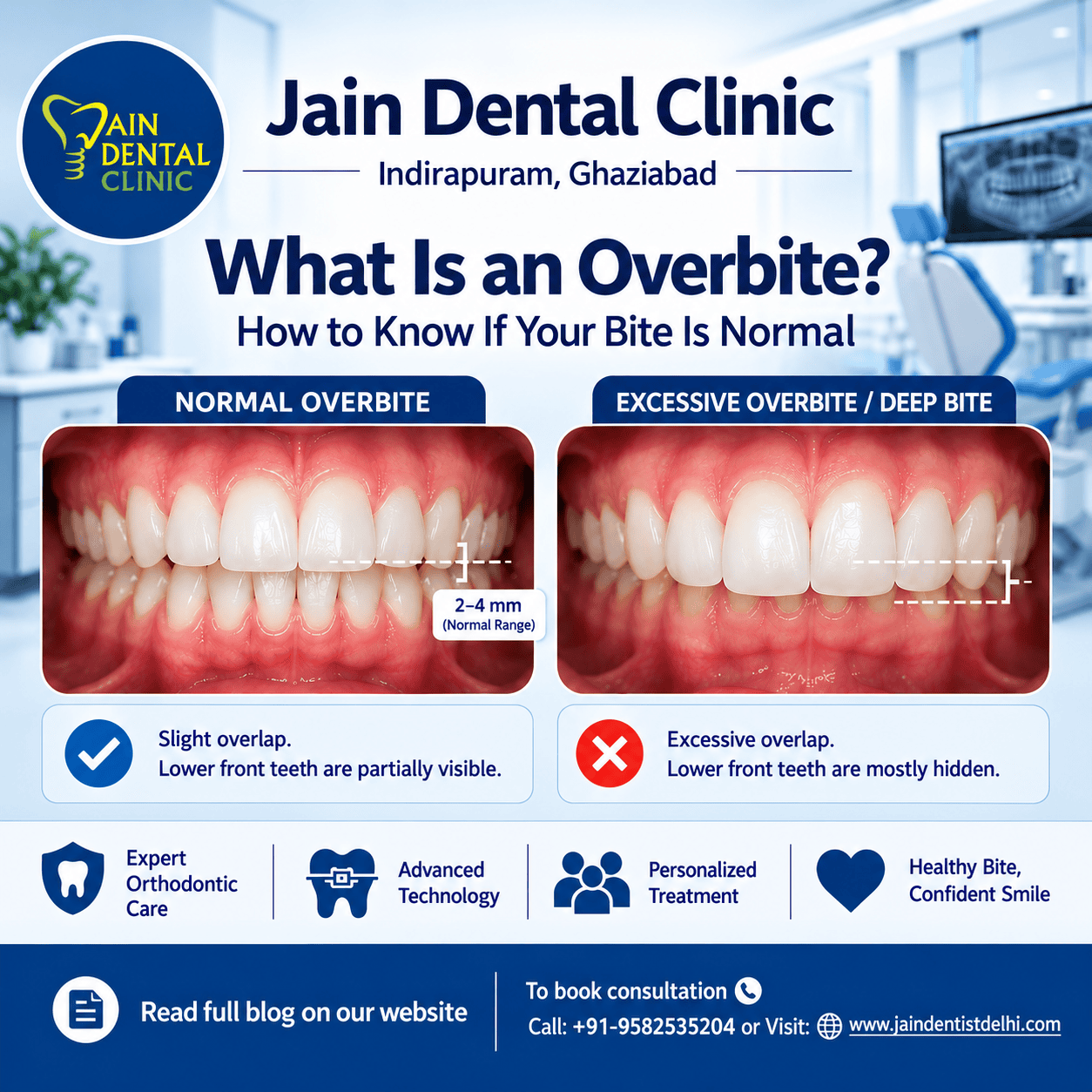
- An overbite is normal when the upper front teeth slightly overlap the lower teeth. An excessive overbite may be a deep bite and can affect tooth wear, chewing, or comfort.
- Overbites can be dental or skeletal. Dental overbites mainly involve tooth position, while skeletal overbites involve the underlying jaw relationship. Treatment depends on the cause and severity.
- You cannot reliably diagnose an overbite at home. If your lower teeth are mostly hidden, touch your gums or palate, or you notice tooth wear, chewing problems, or jaw discomfort, consider a professional orthodontic assessment.
- Not every overbite needs treatment. Mild cases without symptoms may simply be monitored, while clear aligners, braces, or other approaches may be considered when treatment is appropriate.
If you notice these signs or are unsure whether your bite is normal, schedule a consultation with an orthodontist for a proper assessment.
Want to understand what your bite may be telling you? Read the complete guide to learn how normal and excessive overbites differ, what causes them, and when professional evaluation may help.
If you have noticed that your upper teeth cover your lower teeth more than expected, you may wonder, what is an overbite and whether your bite is normal. A small overbite is a normal part of healthy bite alignment, but excessive overlap may indicate a deep bite and sometimes affect chewing, tooth wear, or comfort. This guide explains what a normal overbite looks like, how to recognise possible warning signs, and how overbite differs from other bite problems such as overjet. You will also learn about dental and skeletal overbites, common causes, diagnosis, and when treatment may be appropriate. If you are in Delhi NCR or Ghaziabad and are unsure about your bite, a professional assessment can provide clarity.
You’ve probably looked in the mirror at some point and wondered whether your upper teeth cover your lower teeth more than they should. Maybe a dentist mentioned the word “overbite” and you left the appointment not entirely sure what it meant. Maybe you’ve noticed your child’s bite looks a little different and you’re not sure whether to be concerned.
Here’s something that surprises many people: almost everyone has an overbite. The presence of vertical overlap between the upper and lower front teeth is not a problem in itself — it’s a normal feature of a healthy bite. The question that actually matters is whether the overlap falls within an expected range or whether it has become excessive.
This article explains what an overbite is, what a generally normal bite looks like, how overbite differs from related bite conditions, and which signs suggest that a professional assessment may be appropriate. By the time you finish reading, you will have a clear picture of what your bite should look like — and when it might be worth getting it checked by an orthodontist.
What Is an Overbite?
This section covers the definition of an overbite, what it looks like, and how much vertical overlap is considered normal. Understanding these basics will help you make sense of everything that follows.
Overbite Meaning in Simple Terms
An overbite is the vertical overlap of your upper front teeth over your lower front teeth when your mouth is closed and your teeth are together. Think of it as how much of your lower front teeth your upper front teeth “cover” when you bite down.
Some degree of this overlap is expected. The upper front teeth are designed to sit slightly in front of and over the lower front teeth — this arrangement helps you bite into food efficiently and protects the edges of your teeth from excessive wear.
The concern arises when the overlap is larger than expected. At that point, the overbite may begin to affect how your teeth function, how your jaw moves, and, in more pronounced cases, the health of your teeth and gums.
What Does a Normal Overbite Look Like?
In a generally normal bite, your upper front teeth overlap your lower front teeth by a small amount. Your lower front teeth should be partly visible — not entirely hidden — when your teeth are together. The back teeth (molars and premolars) should fit together comfortably, and biting and chewing should feel smooth and even.
Appearance alone can be misleading, though. Some bites that look fairly typical from the outside may involve bite relationships that warrant attention, while others that look slightly uneven may be functioning perfectly well. This is why a professional assessment matters — what you see in the mirror gives you a starting point, not a diagnosis.
How Much Overbite Is Normal?
Orthodontists measure overbite in millimeters — specifically, how many millimeters of the lower front teeth are covered by the upper front teeth when biting down. According to a study published in the Journal of Orthodontic Science (archived on PMC) established the normal value for an overbite a vertical overlap of 2 to 4 millimeters is generally considered normal and is necessary for proper bite function.
When the overlap extends significantly beyond this range, orthodontists may classify it as a deep bite or excessive overbite. At that stage, it may be worth evaluating whether any functional problems are developing — though even then, treatment is not automatically necessary for every person.
It is also worth noting that a single number is not an absolute line between normal and abnormal. Orthodontists consider bite measurements alongside other factors, including tooth position, jaw relationship, tooth wear, and whether any symptoms are present.
Overbite vs Other Types of Bite Problems
An overbite is one of several types of malocclusion (the term orthodontists use for a misaligned bite). Understanding how it compares to other bite relationships helps clarify what you are actually dealing with.
| Term | What It Measures / Describes | What It Looks Like |
|---|---|---|
| Overbite | Vertical overlap of the upper and lower front teeth | Upper front teeth cover the lower front teeth when biting down |
| Overjet | Horizontal distance between the upper and lower front teeth | Upper front teeth sit farther forward than the lower front teeth |
| Underbite | Lower front teeth positioned ahead of the upper front teeth | Lower front teeth sit in front of the upper front teeth when the mouth is closed |
| Crossbite | Abnormal side-to-side relationship between upper and lower teeth | One or more upper teeth bite inside the lower teeth |
| Open bite | Lack of vertical contact between opposing teeth | A visible gap remains between certain upper and lower teeth when biting down |
What Is the Difference Between Overbite and Overjet?
Overbite describes a vertical relationship — how much one set of teeth overlaps the other when you bite down. Overjet describes a horizontal relationship — how far the upper front teeth protrude forward beyond the lower front teeth.
A simple way to think about it: overbite measures up and down; overjet measures front to back. These two conditions are often confused, and it is quite common for a person to have both at the same time. Someone who has been told they have “buck teeth,” for example, typically has significant overjet — not just overbite.
Is an Overbite the Same as a Deep Bite?
Not exactly, though the terms are closely related. Deep bite is the orthodontic term used when an overbite is more pronounced than expected — when the upper teeth cover an unusually large portion of the lower front teeth. All deep bites are overbites, but a mild overbite within the 2–4 mm range is not a deep bite.
In everyday conversation, some people use these terms interchangeably, which is why they can be confusing. When an orthodontist uses the term “deep bite,” they are typically referring to a more significant degree of overlap that may warrant closer attention.
What Is a Dental Overbite vs a Skeletal Overbite?
This distinction matters significantly for treatment planning, and it is something that need explanation in depth. Understanding whether an overbite is primarily related to tooth position or to the underlying jaw structure changes how it is assessed and how it may be treated.
What Is a Dental Overbite?
A dental overbite is one where the main contributing factor is the position, angle, or eruption pattern of the teeth — rather than a significant jaw size or shape discrepancy. In these cases, the jaws themselves may be in a reasonably normal relationship, but the teeth are positioned in a way that creates excessive vertical overlap.
Contributing factors may include:
- Upper front teeth positioned too far downward: When the upper front teeth have over-erupted (grown further than expected), they can cover more of the lower teeth than they should.
- Lower front teeth positioned or angled differently: Changes in the position or inclination of the lower front teeth can alter how much of them is visible when biting down.
- Tooth angulation or crowding: The way individual teeth are angled or crowded can influence the overall appearance and depth of the bite.
What Is a Skeletal Overbite?
A skeletal overbite is more closely connected to the underlying relationship between the upper and lower jaws — their size, position, or pattern of vertical growth. In these cases, the overbite is not simply a matter of where the teeth sit, but how the jaw structures themselves have developed.
Contributing factors may include:
- Jaw growth pattern: The upper and lower jaws can grow at different rates or in different directions, creating a mismatch in their vertical relationship.
- Vertical facial development: Some people have a facial growth pattern that results in a shorter or deeper lower jaw relationship.
- Relative jaw position: The lower jaw sitting further back relative to the upper jaw can contribute to deeper bite depth.
- Genetic influences: Jaw structure tends to run in families, which is why overbites often appear across generations.
Dental vs Skeletal Overbite: What’s the Difference?
| Feature | Dental Overbite | Skeletal Overbite |
|---|---|---|
| Main cause | Tooth position or angulation | Underlying jaw relationship or growth pattern |
| Primary structure involved | Teeth | Jaws and facial skeleton |
| Can tooth movement help? | Often, depending on severity | May help in some cases, but skeletal problems can require additional approaches |
| How is it evaluated? | Clinical orthodontic examination | Clinical examination, often alongside diagnostic imaging when appropriate |
| Treatment planning | Focuses mainly on tooth movement | May require assessment of both tooth position and jaw relationship |
Can You Tell Whether Your Overbite Is Dental or Skeletal at Home?
This is a question worth answering honestly: no, you generally cannot. Distinguishing between a dental and skeletal overbite requires a professional orthodontic examination that evaluates both tooth position and jaw relationship. In some cases, diagnostic imaging — such as a lateral X-ray (a side-view image of the skull and jaw) — is used to assess the underlying skeletal structures.
This is not meant to discourage you from observing your own bite. Self-observation is a reasonable first step. But it is a starting point, not a conclusion.
What Does a Normal Bite Look Like?
It helps to have a clear picture of what healthy bite alignment generally involves, so that you have a reference point when thinking about your own teeth.
Signs of a Generally Normal Bite
A generally normal bite tends to have the following characteristics:
- Slight vertical overlap of the upper front teeth: The upper teeth sit just over the lower front teeth, covering them by a small amount. The lower teeth remain at least partially visible.
- Comfortable contact between opposing teeth: Back teeth fit together evenly when biting down, with pressure distributed across multiple teeth rather than concentrated on just a few.
- Smooth, comfortable chewing: Biting and chewing feel effortless, without clicking, shifting, or discomfort.
- No significant interference: The teeth do not catch on each other or deflect the jaw when coming together.
- No obvious excessive tooth wear: The edges of the front teeth are relatively even, without significant chipping, shortening, or flattening from abnormal contact.
Are Upper Teeth Supposed to Cover Lower Teeth?
Yes — to a degree. The slight overlap of the upper teeth over the lower teeth is not only normal, it is functional. This arrangement helps guide your bite as your jaw closes, protects the biting edges of the lower teeth, and allows efficient cutting and tearing of food. A bite where there is no overlap at all — an open bite — can actually create its own set of functional challenges.
Can a Bite Look Normal but Still Have an Orthodontic Problem?
Yes, and this is an important point. Some bite problems involve relationships between the teeth or jaws that are difficult to identify through simple self-observation. A person may have no obvious visual signs of concern but still have a bite relationship that is placing uneven stress on their teeth, jaw joints, or surrounding tissues. This is one reason why routine dental check-ups — and orthodontic evaluations when appropriate — are valuable even when nothing looks obviously wrong.
How to Know If You Have an Overbite?
If you are reading this article, you have probably already noticed something about your bite that prompted the question. Here is how to think about what you are observing.
Signs You May Have an Overbite
Some signs that your overbite may be beyond the typical range include:
- Upper teeth noticeably covering the lower teeth: If your lower front teeth seem almost entirely hidden when you bite down, the overlap may be greater than expected.
- Lower front teeth appear unusually short or hidden: This is often the first visual sign that prompts people to look more closely at their bite.
- Lower teeth contacting the palate or gum tissue: In more pronounced deep bites, the lower front teeth may press against the gum tissue or the roof of the mouth behind the upper front teeth.
- Tooth wear or chipping on the front teeth: Unusual wear or chipping along the edges of the lower front teeth can sometimes indicate that the bite is placing excessive pressure on those teeth.
- Difficulty biting or chewing certain foods: Discomfort or inefficiency when biting can sometimes be related to bite depth.
- Jaw discomfort or tension: Some people with a deeper overbite notice jaw fatigue, discomfort, or tension, particularly after eating.
Can You Check Your Overbite at Home?
You can observe your bite at home by biting down gently in front of a mirror and looking at how much of your lower front teeth your upper teeth cover. If your lower teeth are mostly or entirely hidden, that may be worth mentioning to a dentist or orthodontist.
What you observe in the mirror can give you a general sense of whether your bite warrants a closer look. It cannot, however, tell you how deep the overlap actually is in millimeters, whether the underlying cause is related to tooth position or jaw structure, or whether any changes are occurring over time. Home observation is a useful first step — just not the last one.
When Should You Have Your Bite Checked?
Consider scheduling a professional assessment if you notice:
- Noticeably excessive overlap: Your upper teeth cover far more of your lower teeth than seems usual.
- Pain or discomfort in the jaw: Especially if it is recurring or worsening.
- Difficulty chewing: Certain textures feel difficult to bite into or break down comfortably.
- Tooth wear or chipping: Particularly along the edges of the lower front teeth.
- Contact between the lower teeth and soft tissue: Lower teeth touching the gum tissue or palate when biting.
- Concerns about a child’s developing bite: Early evaluation in children allows the bite to be monitored at the most appropriate time for any intervention.
What Causes an Overbite?
There is no single cause of an overbite. In most cases, several factors contribute — and the mix differs from one person to the next.
Genetic Factors
Genetics plays a significant role in how your jaws develop and how your teeth are positioned. The shape of your upper and lower jaws, the size relationship between them, and certain tooth characteristics can all be inherited. If an overbite or deep bite runs in your family, that does not mean treatment is inevitable — but it does help explain why the pattern appears.
Jaw Growth and Development
The way the jaws grow during childhood and adolescence can influence bite depth significantly. The lower jaw in particular continues developing well into the teenage years. If the upper and lower jaws grow at different rates or in different vertical directions, the bite relationship can shift over time. This is one reason why monitoring bite development in children is valuable — not because every child will need treatment, but because early awareness allows for better timing if treatment becomes appropriate.
Tooth Position and Alignment
The position and angle of the teeth themselves can create or contribute to a deeper bite. Upper front teeth that have over-erupted (dropped lower than expected) or lower front teeth that are positioned unusually can both alter how much vertical overlap exists. Crowding or spacing patterns in the dental arch can also affect bite depth.
Childhood Oral Habits
Certain habits during early childhood can influence how the teeth and jaws develop:
- Thumb-sucking: Prolonged thumb-sucking, particularly beyond the age of three or four, can place pressure on the upper front teeth and the developing jaw, potentially affecting bite alignment.
- Pacifier use: Extended pacifier use can have a similar effect. The impact depends on both the duration and intensity of the habit.
- Tongue thrusting: This occurs when the tongue pushes against or between the teeth during swallowing. Over time, the pressure can affect tooth position and bite alignment.
Teeth Grinding and Other Contributing Factors
Bruxism (teeth grinding or clenching, often during sleep) can contribute to changes in bite depth over time by wearing down tooth surfaces and altering the way teeth contact each other. Nail-biting and habitually chewing on objects can also place uneven pressure on the teeth. These factors do not cause an overbite on their own in most cases, but they can contribute to changes — particularly in an adult whose bite was already on the deeper side.
What Problems Can an Excessive Overbite Cause?
A mild overbite within the normal range generally causes no problems at all. The complications described below are associated with more pronounced or excessive overbites — and even then, not every person with a deep bite will experience all of them.
Tooth Wear and Enamel Damage
Excessive tooth wear is one of the more common consequences of a deep bite. When the lower front teeth contact the back surface of the upper front teeth more forcefully than they should, the enamel (the hard outer layer of the tooth) can wear down over time. The lower front teeth are often most affected, but the upper teeth can also show wear patterns depending on the bite relationship.
Difficulty Biting and Chewing
Functional challenges can develop when the bite depth interferes with how the upper and lower teeth work together. Some people find it difficult to bite into certain foods cleanly, or notice that chewing is less efficient than it should be. This tends to be more noticeable with more pronounced overbites.
Trauma to the Gums or Roof of the Mouth
In deeper overbites, the lower front teeth may contact the gum tissue behind the upper front teeth or even the palate (roof of the mouth) when biting down. Repeated contact with soft tissue can cause local irritation and, over time, may affect gum health in that area.
Oral Hygiene Challenges
Crowded or misaligned teeth — which often accompany a deeper bite — can make brushing and flossing more difficult. Areas where teeth are tightly overlapping or where the bite is placing pressure on certain zones can be harder to clean thoroughly, increasing the risk of plaque accumulation, cavities, and gum inflammation.
Jaw Discomfort
Jaw joint strain is another possible consequence of a significantly deep bite. When the bite relationship places the jaw joints (the temporomandibular joints, or TMJ) in a less-than-ideal position, some people develop discomfort, tension, or clicking in the jaw area. This does not occur in every case of deep bite, but it is worth noting — particularly if you already experience any of these sensations.
Changes in Smile or Facial Appearance
Facial aesthetics can be affected by a more pronounced overbite, particularly when a skeletal component is involved. Some people notice that the chin appears less defined, or that the profile looks slightly imbalanced. These concerns are valid, though it is worth noting that appearance alone is rarely the primary clinical reason to recommend treatment — function and long-term oral health typically guide that decision.
How Is an Overbite Diagnosed?
A professional diagnosis involves considerably more than a quick look in the mirror. Here is what an orthodontic evaluation typically includes.
What Does an Orthodontist Examine?
During a clinical assessment, an orthodontist evaluates a range of factors:
- Tooth position: Where each tooth sits within the dental arch, and whether any are over-erupted, tilted, or crowded.
- Overbite and overjet: The vertical and horizontal overlap between the upper and lower front teeth, measured in millimeters.
- Bite relationship: How the back teeth fit together on both sides.
- Jaw relationship: The position of the upper and lower jaws relative to each other.
- Tooth wear: The presence and pattern of any unusual wear on the tooth surfaces.
- Facial profile: The overall balance and proportions of the face, which can help identify skeletal contributions to the bite.
- Oral health: The health of the gums, supporting bone, and surrounding tissues.
Are X-Rays Needed to Evaluate an Overbite?
Not always, but sometimes. For many patients, a clinical examination provides enough information to form an initial picture of the bite. However, when a skeletal contribution to the overbite is suspected, a lateral X-ray — a side-view image of the skull, jaws, and teeth — can help the orthodontist assess the underlying jaw relationship more precisely. Other imaging, such as dental X-rays or a panoramic (full-arch) X-ray, may also be used to evaluate tooth position, root length, and bone support.
How Do Orthodontists Determine the Severity of an Overbite?
Severity is assessed across several dimensions: the actual measurement of vertical overlap, the proportion of the lower teeth that is covered, whether the lower teeth are contacting soft tissue, the presence and pattern of tooth wear, the extent to which skeletal factors are involved, and whether any functional problems — such as jaw discomfort or difficulty chewing — are already present. No single measurement alone determines severity; these factors are considered together.
Does Every Overbite Need Treatment?
This is one of the most common questions people have — and the honest answer is no, not every overbite requires treatment.
When a Mild Overbite May Not Need Treatment
A mild overbite within the 2–4 mm range that is not causing functional problems, tooth wear, or discomfort generally does not require active treatment. Regular monitoring during routine dental visits allows any gradual changes to be identified early, but intervention is not automatically recommended simply because an overbite exists.
When Treatment May Be Recommended
Treatment becomes more appropriate when the overbite is causing — or is likely to cause — functional problems. These might include progressive tooth wear, lower teeth contacting soft tissue, jaw joint discomfort, difficulty chewing, or challenges maintaining oral hygiene. In children and teenagers, the timing of skeletal growth can also make earlier evaluation worthwhile, since some issues are easier to address while the jaw is still developing.
Why the Cause of the Overbite Matters
A dental overbite and a skeletal overbite may look similar on the surface but require different treatment approaches. Correcting tooth position alone may not be sufficient if an underlying jaw relationship is contributing to the problem. This is precisely why identifying the cause — through a proper examination — is an important part of deciding whether, when, and how to treat an overbite.
How Is an Overbite Treated?
Treatment depends on several factors: the cause of the overbite, its severity, whether it is primarily dental or skeletal, and your age. There is no single approach that works for every person.
Clear Aligners
Clear aligners are removable orthodontic trays that gradually shift the teeth into a more desirable position. For certain types of dental overbites — particularly those involving tooth position or angulation — clear aligners can be an effective treatment option. They offer the advantage of being less visible than traditional braces and can be removed for eating and cleaning.
However, case selection matters. Clear aligners are generally well-suited to mild-to-moderate dental overbites where the primary issue is tooth position. For more complex cases—particularly skeletal deep bites—recent systematic reviews indicate that the efficacy of clear aligners remains uncertain. These cases often require full-fixed appliances (traditional braces), adjunct mechanics, or planned overcorrection to achieve stable, predictable results.
Traditional Braces
Fixed braces (metal or ceramic brackets bonded to the teeth) remain one of the most versatile and reliable tools for correcting overbite. Braces can move teeth in multiple directions simultaneously and, when used with elastics (small rubber bands connecting the upper and lower brackets), can help address the bite relationship directly. They are suitable for a wide range of overbite severities and ages.
Orthodontic Appliances
Growth guidance appliances are sometimes used in younger patients whose jaws are still developing. These devices — which may include palate expanders, functional appliances, or headgear — work by influencing the direction and pace of jaw growth rather than simply moving teeth. They are most effective during the period when the jaw is actively growing, which is why early evaluation can be particularly valuable for children.
Treatment for Skeletal Overbite
When a skeletal jaw discrepancy is the primary driver of the overbite, tooth movement alone may not fully resolve the issue. In growing patients, appliances that guide jaw development can sometimes reduce the skeletal component. In adults whose jaw growth is complete, the options depend on the severity. Many adults with skeletal contributions to their overbite can still achieve significant improvement through orthodontic treatment alone. However, in cases where the jaw discrepancy is pronounced and the functional impact is significant, orthognathic surgery (jaw surgery to reposition one or both jaws) may be considered alongside orthodontic treatment.
Can Clear Aligners Fix an Overbite?
Yes—for the right type of case. Systematic reviews published in recent years have confirmed that clear aligners can effectively correct mild-to-moderate overbites, particularly those driven by tooth position. However, evidence shows their effectiveness is limited for skeletal deep bites, which frequently require traditional fixed braces or targeted overcorrection. The only way to know whether clear aligners are appropriate for your specific bite is through a professional orthodontic assessment.
Overbite in Children vs Adults
Age plays a meaningful role in how an overbite is assessed and how it can be treated.
Overbite in Children
Children’s jaws are still growing, which creates both opportunities and reasons for careful monitoring. A bite that looks deep at age seven may change as the permanent teeth come in. On the other hand, growth is also the window during which certain jaw-related problems are most efficiently addressed. The American Association of Orthodontists recommends an initial orthodontic evaluation by age seven — not because most children need treatment at that age, but because it allows the developing bite to be assessed in context. Many children simply require monitoring.
Overbite in Teenagers
Adolescence is often the most active period for orthodontic treatment because significant jaw growth is still occurring, particularly in the early teenage years. Braces or clear aligners paired with appropriate growth-guidance mechanics can address both dental and, in some cases, mild skeletal contributions to the overbite during this window. Treatment outcomes in teenagers are often more straightforward than in adults for this reason.
Overbite in Adults
Adult teeth respond well to orthodontic treatment — the process simply relies on different mechanisms than growth guidance. Tooth movement through braces or aligners is effective at any age. The key difference in adult cases is that the jaws are no longer growing, which means that if a significant skeletal discrepancy is present, orthodontic treatment alone may achieve only partial correction. This needs to be discussed honestly during a consultation, with realistic expectations on both sides.
Can an Overbite Get Worse With Age?
For many people, the answer is yes — gradually, and particularly if certain contributing factors are present.
Tooth wear caused by abnormal contact between the upper and lower teeth can deepen over time, progressively altering the bite relationship. Bruxism (teeth grinding), if untreated, accelerates this process. As tooth surfaces wear down unevenly, the bite can shift in ways that increase the depth of the overbite further.
Changes in bone density and jaw support as part of normal aging can also allow teeth to drift or shift slightly over time. In people who have lost back teeth and not replaced them, the front teeth can come under increased pressure, leading to changes in bite depth.
None of this means that an overbite diagnosed in your twenties will inevitably become severe by your fifties. But it does mean that monitoring is worthwhile — and that addressing a progressive overbite earlier, rather than waiting, tends to produce better long-term outcomes.
Frequently Asked Questions (FAQ) About Overbite
Is an overbite normal?
Yes. A small vertical overlap of the upper front teeth over the lower front teeth is completely normal and is present in most people. The overlap becomes a clinical concern when it is significantly greater than the typical range or when it is causing functional problems, tooth wear, or discomfort.
How much overbite is normal?
A vertical overlap of approximately 2–4 mm is generally considered within the normal range, according to a study published in the Journal of Orthodontic Science (archived on PMC). This allows the upper front teeth to cover roughly one-quarter to one-third of the lower front teeth. An overlap significantly beyond this range may be classified as a deep bite.
What does a normal bite look like?
In a normal bite, the upper front teeth slightly overlap the lower front teeth, the lower teeth remain at least partly visible, and the back teeth fit together evenly on both sides. Biting and chewing feel comfortable, with no significant clicking, jaw shifting, or uneven pressure.
How do I know if I have an overbite?
You may have an excessive overbite if your lower front teeth appear largely hidden when you bite down, if your lower teeth contact the gum tissue or roof of your mouth, or if you notice jaw discomfort or unusual wear on the front teeth. A professional orthodontic assessment is needed to confirm this.
What is the difference between overbite and overjet?
Overbite measures the vertical overlap — how much the upper teeth cover the lower teeth when biting down. Overjet measures the horizontal distance — how far the upper front teeth protrude in front of the lower front teeth. Both can occur together, and both require separate assessment.
Is a deep bite the same as an overbite?
A deep bite is a more pronounced version of an overbite — one that exceeds the typical range and may cause functional or structural concerns. All deep bites are overbites, but not all overbites are deep bites. The term “deep bite” generally signals a level of overlap that warrants orthodontic evaluation.
What is a dental overbite?
A dental overbite is one where the primary cause is related to the position, angle, or eruption pattern of the teeth, rather than a significant mismatch in jaw size or structure. Dental overbites are often addressed through tooth movement alone, using braces or clear aligners.
What is a skeletal overbite?
A skeletal overbite is related to the size, position, or growth pattern of the upper and lower jaws themselves — rather than simply the teeth. Because the underlying jaw relationship is involved, treatment may need to address both tooth position and the jaw structure, particularly in adults.
Can a dental overbite be fixed with clear aligners?
In many cases, yes. Clear aligners are effective for correcting dental overbites of mild-to-moderate severity. The specific approach depends on your tooth position, bite depth, and overall jaw relationship. An orthodontic assessment will determine whether clear aligners are appropriate for your individual situation.
Can a skeletal overbite be fixed without surgery?
It depends on the degree of the skeletal discrepancy and your age. In growing patients, jaw growth can sometimes be guided to reduce the skeletal component. In adults with mild-to-moderate skeletal contributions, orthodontic treatment alone can often produce meaningful improvement. Significant skeletal discrepancies in adults may occasionally require a combined surgical and orthodontic approach — but this represents the more complex end of the spectrum.
Can an overbite get worse with age?
It can, particularly when tooth wear, bruxism (teeth grinding), or tooth loss are involved. These factors gradually alter the bite relationship over time. Monitoring and, where appropriate, early treatment can help slow or prevent this progression.
Conclusion: Find Out Whether Your Overbite Is Normal
Here is what this article has covered, in brief:
- A small overbite is normal. The presence of some vertical overlap between the upper and lower front teeth is expected and necessary for a healthy bite.
- An excessive overbite is different. When the overlap significantly exceeds the 2–4 mm range, it may be classified as a deep bite and may warrant closer evaluation.
- Overbites have different causes. Some are primarily related to tooth position (dental overbite); others involve the underlying jaw relationship (skeletal overbite). The distinction matters for treatment planning.
- Not every overbite needs treatment. Mild overbites without functional impact are often simply monitored. Treatment becomes more appropriate when the overbite is causing or is likely to cause problems.
- You cannot reliably assess this at home. What you see in the mirror is a starting point, not a clinical conclusion.
If you are unsure whether your bite is within a normal range — or if you have noticed any of the signs described in this article — a professional assessment is the most reliable next step.
Schedule Your Consultation Today
Understand Whether Your Overbite Is Normal with a Professional Orthodontic Evaluation
Now that you understand what an overbite is—from normal vertical overlap and deep bite to the differences between dental and skeletal overbites—the next step is understanding whether your bite falls within a healthy range. Since every patient’s teeth, bite, jaw relationship, and oral-health needs are different, a professional orthodontic evaluation can help determine the severity and underlying cause of an overbite and whether treatment is appropriate.
At Jain Dental Clinic, Dr. Arpan Pavaiya Jain and Dr. Rashi Agarwal Jain can evaluate your teeth, bite alignment, jaw relationship, tooth wear, and overall oral health and explain their findings in clear, simple terms. Whether you have noticed excessive overlap, lower teeth contacting your gums or palate, tooth wear, chewing difficulty, or concerns about your child’s developing bite, our team can help identify the underlying factors and discuss whether orthodontic treatment, including clear aligners, may be suitable for your individual needs.
📞 Call: +91-9582535204
🌐 Visit: www.jaindentistdelhi.com
Medical Advice Disclaimer:
The information provided in this article is for general educational and informational purposes only and is not intended as professional medical or dental advice, diagnosis, or treatment. While we strive for accuracy, every patient’s dental anatomy and clinical needs are unique. Always seek the advice of your dentist or another qualified healthcare provider with any questions you may have regarding a medical condition. Never disregard professional medical advice or delay seeking it because of something you have read on this website

Dr. Arpan Pavaiya Jain (BDS, MDS – Prosthodontics) is a prosthodontist and implantologist with more than 25 years of experience. He studied at KGMC Lucknow and leads Jain Dental Clinic in Indirapuram, Ghaziabad. His focus is dental implants, crowns and bridges, dentures, full mouth rehabilitation, and Invisalign clear aligners.