Crowded Teeth: What They Are and Why They Matter
What crowded teeth are, and why they matter. Crowded teeth are what you get when the jaw is smaller than the set of teeth it must hold, so they overlap or twist. They matter because the tight gaps between them are hard to clean, and that is where decay and gum trouble usually begin.
The cause is usually inherited, not something you did. Larger teeth from one side of the family, a narrower jaw from the other. When the two do not match, there is too little room from the start. Wisdom teeth get most of the blame, but the evidence does not back that up.
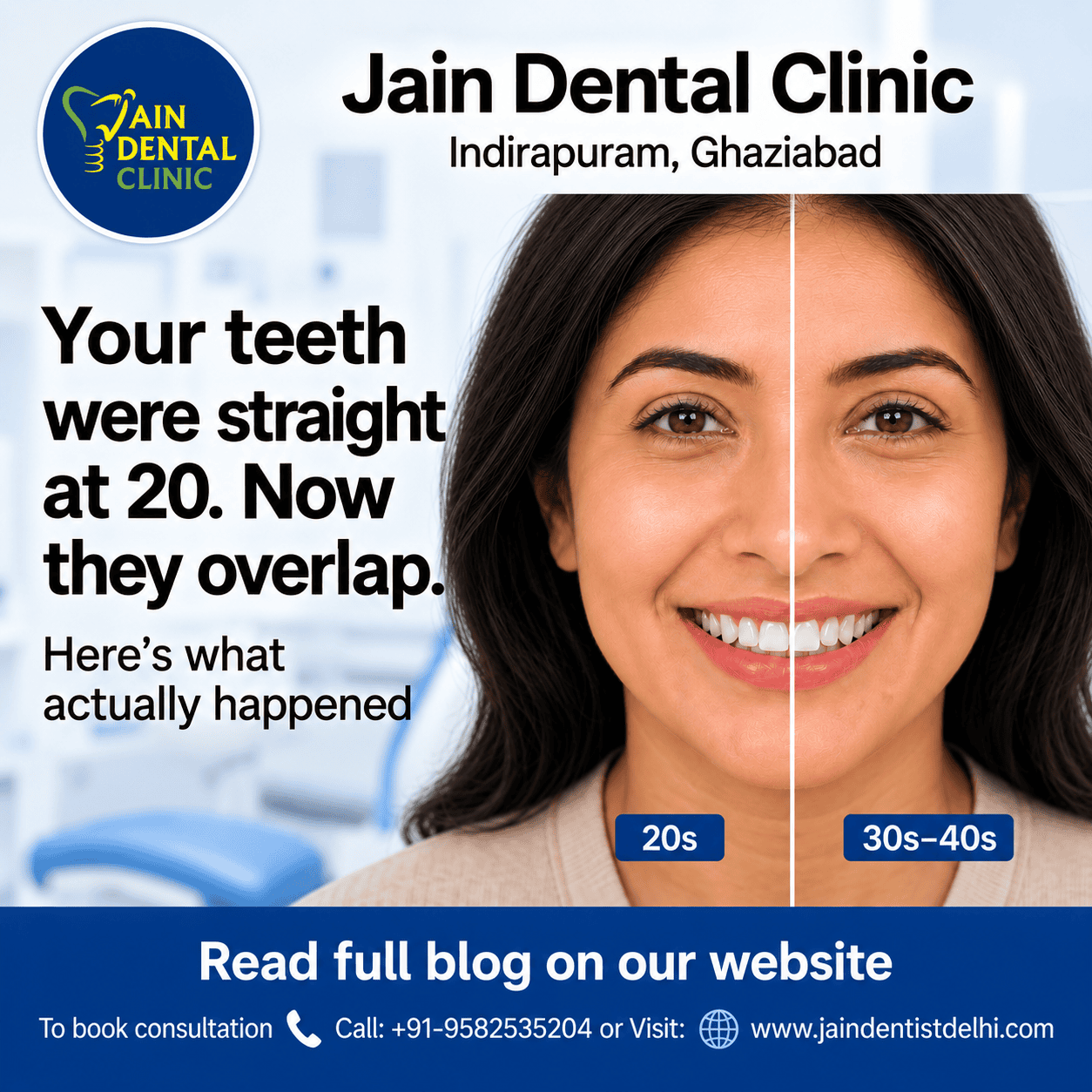
Teeth that shifted in adulthood are normal, not neglect. If your teeth were straight at twenty and overlap now, your dental arch has slowly narrowed with age. For anyone who once wore braces, giving up the retainer is the most common reason. Age is not a barrier to correcting it.
Watch the spot you cannot clean. This is the practical takeaway. If floss shreds or catches in the same place every night, or your gums bleed in one small area, that surface is not being cleaned properly. Show it to your dentist rather than working harder at it.
The full article explains each of these in plain language: the five real causes of crowding, what changes quietly in your mouth over the years, and how dentists actually measure how much space is missing. It is worth the ten minutes if any of the above sounded familiar.
If you recognize these signs in your own teeth or your child’s, a short consultation will tell you exactly where you stand and what, if anything, needs doing.
Do your front teeth overlap in photos? Does floss catch in the same spot every night? Many people across Delhi NCR and Ghaziabad quietly wonder whether this is normal. This guide explains crowded teeth causes and effects in plain language, with no scare stories. You will learn what dental crowding really is and why your jaw runs out of space. We cover how mild, moderate and severe crowding differ. We also explain why crowded teeth in adults often appear years after braces. You will see what happens in the tight spots you cannot clean, and which signs are worth showing to a dentist. Whether you are checking your own smile or your child’s, the answers here are honest and practical. Read the full post for a clear picture of where you stand.
Maybe you noticed it in a photo. Your front teeth sit slightly on top of each other. Or maybe your floss tears in the same spot every night, no matter how carefully you use it.
Most people who notice this ask the same quiet question. Is this normal, or is it something I should worry about?
Crowded teeth are very common, and mild crowding is rarely an emergency. But it is not only about how your smile looks. This guide explains crowded teeth causes and effects in simple language — why teeth run out of space, what slowly changes in your mouth over the years, and which signs are worth a check-up.
No scare stories here. Just what a dentist would tell you if you asked across the table.
Let’s start with what crowding actually means.
What Are Crowded Teeth?
Crowding is easier to understand than it sounds. This section explains what is actually happening inside your mouth, and why the problem is about space rather than shape.
Crowded teeth are what you get when the jaw is smaller than the set of teeth it has to hold. With too little space, teeth overlap, twist, or sit slightly forward or back of where they should.
Think of a shelf built for eight books. Try to fit ten, and some will lean, some will tilt, and one will end up sitting in front of the others. Your teeth do the same thing.
Your dentist may call this dental crowding. It is also one form of malocclusion (a bite that does not line up the way it should). Malocclusion is simply the umbrella term for teeth and jaws that do not meet neatly.
It can affect the top row, the bottom row, or both at the same time. It is most common in the lower front teeth, which is why many people notice it there first.
If this sounds like you, you are in very ordinary company. Some degree of crowding is normal, and a perfectly aligned set of teeth is the exception rather than the rule. Noticing overlapping teeth does not mean something has gone wrong with your mouth.
Crowded Teeth vs Crooked Teeth: What’s the Difference?
People use these two words as if they mean the same thing. They are close, but not identical.
Crowded teeth are a space problem. There is not enough room in the jaw, so teeth push against each other and overlap.
Crooked teeth are a position problem. A tooth sits at an angle or turns to one side, even when there is enough space around it.
The difference matters because the cause is different. Crowding usually comes down to jaw size and tooth size. A single crooked tooth can happen for other reasons, such as an injury or a tooth that came through at an odd angle.
In real life, the two often appear together. Crowding pushes teeth out of line, so crowded teeth usually look crooked too. That is why most people notice the crookedness first and the lack of space second.
Types of Dental Crowding
Not all crowding is the same. Dentists sort it by how much space is missing, because that single number shapes everything from your cleaning routine to whether treatment is worth considering. Here is how the levels are usually described.
Your dentist does not simply look and say “a little crooked.” They measure the gap between the space your teeth need and the space your jaw actually has. That difference is measured in millimetres.
| Type | Space missing | What it looks like |
|---|---|---|
| Mild | Up to about 3 mm | One or two teeth slightly overlap or turn. Often only the lower front teeth. Easy to miss. |
| Moderate | About 4 to 6 mm | Several teeth clearly overlap or sit sideways. Floss will not pass in some spots. |
| Severe | About 7 mm or more | Teeth look stacked or sit in two rows. Some are pushed right out of the arch. |
Here is what each level tends to mean day to day.
Mild crowding rarely causes trouble on its own. You can usually still clean every surface, though one or two spots take extra care. Many people live with mild crowding their whole lives without a single problem.
Moderate crowding is where daily cleaning starts to slip. There will be at least one place where floss simply will not go in, and that is the spot your dentist will keep an eye on at every visit.
Severe crowding affects more than cleaning. Chewing, speech, and gum health can all be involved, and the teeth pushed furthest out of line are usually the ones under most strain.
Two honest points about these numbers. First, the exact cut-offs vary slightly between dentists, so treat them as a guide rather than a strict rule. Second, you cannot measure this yourself in the mirror. Proper measurement needs a scan or an impression of your teeth, and often an X-ray to see where the roots sit.
Still, knowing the three levels helps you ask better questions at your next appointment.
What Causes Crowded Teeth?
Most people expect one clear reason. In truth, crowding usually comes from a few things working together over many years. Understanding what causes crowded teeth helps explain why it happened to you, and why it is nobody’s fault.
Here are the causes dentists see most often.
Jaw Size and Tooth Size Mismatch
This is the most common reason by far, and it starts before you are born.
Your teeth are sized by one side of your family. Your jaw is sized by the other. If you end up with the larger teeth and the narrower jaw, the two simply do not match. The teeth need more room than the jaw can give.
This is the small jaw big teeth situation, and it explains most crowding seen in dental clinics. Nothing you did caused it. No amount of brushing, chewing, or care would have changed it.
If your parents or siblings have crowded teeth, there is a fair chance you will too. That family pattern is often the first clue.
Wisdom Teeth Pressure
Wisdom teeth get blamed for crowding more than any other cause. The truth is less certain.
The old idea was simple. Wisdom teeth push forward as they come through, and the whole row shifts. It sounds logical, which is why the belief has lasted.
But the research does not clearly support it. Studies find much the same rate of crowding in people who had those teeth taken out in their twenties. So wisdom teeth cannot be the main driver.
What dentists do agree on is smaller. A wisdom tooth that is stuck or coming in sideways can add pressure at the back of the arch. In some people, that may make existing crowding a little worse. It is a contributing factor for some, not the cause for most.
So if you are in your late teens or early twenties and your teeth seem to be moving, do get it checked. Just know that wisdom teeth crowding is only part of a bigger picture.
Childhood Habits
Some habits in early childhood can shape how the jaw grows and where teeth settle.
Thumb sucking and pacifier use. Steady pressure from a thumb or a dummy pushes on soft, growing bone. Past the age of about three or four, this can affect the shape of the upper jaw and the position of the front teeth. Before that age, it is generally not a concern.
Mouth breathing. When a child breathes through the mouth for years, often due to allergies or enlarged tonsils, the tongue sits lower than it should. The tongue normally rests against the roof of the mouth and helps widen the upper jaw from inside. Without that, the jaw can grow narrower.
Tongue thrusting. Some children press the tongue forward against their front teeth each time they swallow. Repeated thousands of times a day, that pressure can move teeth over time.
If you are a parent reading this, please do not blame yourself. These habits are common, most children grow out of them, and their effect varies a great deal from child to child. The thumb sucking and teeth link is real but modest, and it is only one thread in the story.
Losing Baby Teeth Too Early or Too Late
Baby teeth do more than help a child chew. Each one holds a parking space for the adult tooth growing underneath.
Lost too early. If a baby tooth comes out well before its time, usually from decay or a knock, the neighbouring teeth slowly drift into the gap. When the adult tooth is finally ready, its space has shrunk. It comes through at an angle, or gets stuck behind the row.
Lost too late. A baby tooth that refuses to fall out blocks the adult tooth waiting behind it. The adult tooth may then come through behind the baby tooth, giving that double-row look many parents notice around age seven or eight.
This is why dentists like to see children while their teeth are still changing. A small, cheap spacer at the right moment can prevent a much bigger problem later.
Natural Shifting With Age
Here is the cause that surprises people most. Teeth keep moving your whole life.
Many adults tell their dentist the same thing: my teeth were straight at eighteen, and now my lower front teeth overlap. This is a well-known pattern, and it has a few causes working together.
Your lower jaw is still changing. Across decades, the arch gradually tightens at the front. This is slow, and it is normal.
Teeth wear where they touch. Every chew rubs the side surfaces of neighbouring teeth. As they narrow slightly, teeth drift forward to close the gap.
Lips and cheeks push inward. Soft tissue presses on your teeth every day of your life. That gentle, constant pressure adds up.
A missing back tooth changes everything. If a molar was pulled and never replaced, the teeth beside it tip into the space. The shape of the whole arch shifts.
And one more, which is the biggest of all for anyone who has had braces. Stopping your retainer. Teeth have a strong tendency to drift back toward where they started. Retainers hold them in place. When people stop wearing them after a year or two, teeth shifting with age often follows.
If your teeth used to be straight and are not any more, this is usually the explanation — not wisdom teeth, and not anything you did wrong.
Why Crowded Teeth Matter: The Effects
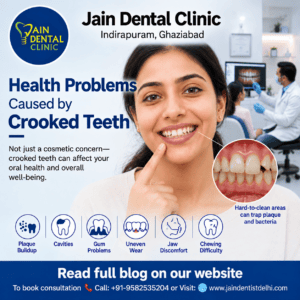
This is the part most people never hear. Crowding is usually treated as a looks issue, but the real story happens quietly, in the tight spots between teeth, over years rather than weeks.
So is crowded teeth bad for your health? For some people, yes. For others, not much at all. The honest answer depends on how severe the crowding is and how well you can clean around it. Here is what can happen, and why.
Harder to Clean Properly
Everything else in this section starts here. Overlapping teeth leave narrow pockets that neither a brush nor floss can properly enter.
A toothbrush cleans flat and curved surfaces well. It cannot get into a narrow gap where one tooth sits partly in front of another. Floss is meant to solve that, but where two teeth press tightly together, floss shreds, catches, or will not go in at all.
Many people with hard to floss crowded teeth assume they are doing it wrong. Usually they are not. The gap is simply too tight for the tool.
The result is one or two spots in your mouth that never get properly cleaned. Not because of poor habits, but because of geometry.
Higher Risk of Tooth Decay
Those uncleaned spots are where decay tends to begin.
Plaque is a soft, sticky film of bacteria that forms on your teeth every day. Brushing removes most of it. Where the brush cannot reach, it stays. Over weeks and months, the bacteria in plaque produce acid that slowly softens the enamel (the hard outer layer of the tooth).
Tooth decay between crowded teeth is easy to miss for a simple reason. It starts on the side surface, hidden between two teeth. You cannot see it in the mirror, and it does not usually hurt until it has gone deep. It usually shows up on an X-ray, and often on both teeth either side of the gap.
This is the practical reason crowding matters. Not the appearance, but the cavity you never saw coming.
Gum Problems
Your gums notice tight spaces too.
Plaque that sits along the gum line hardens into calculus, also called tartar, which brushing cannot remove. The gum next to it becomes inflamed. That early stage is gingivitis (mild gum inflammation), and the usual signs are redness, puffiness, or a little blood when you brush.
Gingivitis is common and reversible. A professional clean and good daily care usually settle it.
If it is left alone for years, it can progress to periodontitis, where the bone supporting the tooth is slowly lost. That stage is not reversible, though it can be halted with treatment.
To be clear, gum disease from crooked teeth is not automatic. Plenty of people with crowding have healthy gums. But crowding makes the tight spots harder to keep clean, and those are exactly the spots where gum problems tend to start.
Bite and Chewing Issues
Teeth are designed to meet each other in a particular way. Crowding can change that.
A tilted tooth meets its opposite number in the wrong spot. The pressure then lands where the enamel was never built to take it. Over many years, that tooth can wear down faster than its neighbours. You may notice a flattened edge, a small chip, or a tooth that feels more sensitive to cold.
Uneven bite problems can also mean some teeth do far more of the work while others barely touch. The overworked teeth take the strain.
This is a slow effect, measured in decades rather than months. Most people never notice it happening. They just notice the result.
Jaw Discomfort and Headaches
This one needs an honest answer rather than a confident one.
You will read that misaligned teeth cause jaw pain and headaches. Sometimes there is a link. A bite that is significantly off can put extra strain on the jaw joint and the muscles around it, which some people feel as soreness, clicking, or tension at the temples.
But the link is not straightforward. Many people with noticeable crowding have no jaw trouble at all. Many people with jaw pain have perfectly straight teeth. Jaw pain has several possible causes, including stress, grinding teeth at night, and joint problems that have nothing to do with alignment.
So jaw pain from misaligned teeth is worth mentioning to your dentist if you have it. Just be careful of any page, or any clinic, that promises straightening will fix it. That is more certainty than the evidence allows.
Confidence and Everyday Comfort
The last effect does not show up on an X-ray, and it is not less real for that.
Some people cover their mouth when they laugh. Some stop short of a full smile in photos. Some rehearse how they will look before a video call. If that is you, it is worth saying plainly: this is a common and reasonable thing to feel.
It is also worth saying the opposite. Many people with crowded teeth think about it exactly never, and that is equally fine. Crowding is not a flaw you are obliged to fix.
The reason to look into it should be your own — whether that is your gum health, a stubborn cleaning spot, or simply wanting to feel easier about your smile. All three are legitimate. None of them needs justifying to anyone.
Crowded Teeth in Adults: Is It Too Late?
A lot of adults quietly assume they missed their window. Braces were a school thing, the thinking goes, and once you are past twenty-five the door has closed. This section clears that up, because the assumption is simply wrong.
Teeth are not fixed in bone like nails in wood. They sit in a socket, held by a thin, living ligament that responds to pressure. That is why teeth drift over the years, and it is the same reason they can be guided back. The mechanism does not switch off at a certain birthday.
So crowded teeth in adults are not a lost cause. Age is not the barrier most people believe it to be. What changes with age is the pace, not the possibility. Adult bone remodels more slowly than a teenager’s, so movement takes longer and needs more patience. That is a difference in timeline, not a closed door.
There is a second thing worth knowing, and it is the more useful half of the answer.
Crowding tends to drift, not stay still. The forces described earlier — the narrowing arch, the daily wear, the constant press of lips and cheeks — do not stop. So crowding that was barely visible at twenty is often clearer at thirty-five. This is normal and usually slow.
Slow drift is not an emergency. Nobody needs to rush. But it does mean waiting is a decision with a cost. Crowded teeth problems are easier to manage when the space deficit is small and the gums are still healthy.
The gum and decay risk builds quietly. This matters more than the movement itself. A tight spot that has gone uncleaned for fifteen years does more damage than one that has gone uncleaned for two.
Here is the practical takeaway. If you have noticed your teeth shifting, you have not missed anything important. You have simply reached the point where it is worth understanding your own situation rather than guessing at it.
And if you decide to do nothing at all, that can be a perfectly sound choice too — as long as it is a choice you made knowingly, and your dentist is keeping an eye on the tight spots.
When Should You See a Dentist?
Mild crowding often needs nothing more than good daily care. Certain signs, though, are worth showing to a dentist — not because something is wrong, but because they suggest a spot in your mouth is not getting cleaned properly.
These are the signs worth booking a check-up for.
Floss tears or gets stuck in the same place every time. One tight contact that shreds floss is the clearest signal there is. It usually means that surface is not being cleaned at all.
Your gums bleed regularly in one particular area. Bleeding in a single spot, again and again, points to plaque sitting somewhere your brush is missing. Bleeding all over is a different matter, but still worth a visit.
Food traps in the same spot after most meals. A gap that catches food daily is a gap that holds bacteria daily. Many people just live with this. It is worth mentioning.
Your teeth have visibly moved in recent years. If a photo from five years ago looks different from the mirror today, that shift is real and worth measuring.
A tooth feels sensitive to cold, or looks worn or chipped. This can point to uneven bite pressure, and it is easier to sort out early.
Your jaw feels tired, sore, or clicks when you chew. This may have nothing to do with your teeth, but it should be looked at rather than guessed about.
Your child’s adult teeth are coming through overlapped or behind the baby teeth. For children, timing matters more than severity. A small step at the right moment can prevent a bigger job later.
What a Check-Up Actually Involves
Many people delay a visit because they are unsure what will happen. For crowding, it is straightforward.
Your dentist will look at how your teeth meet, check the tight spots for early decay or gum inflammation, and usually take an X-ray to see what is happening between the teeth and below the gum line. That is the part you cannot see yourself.
You will leave knowing three things: how much space is actually missing, whether any damage has already started, and whether your situation needs action or just monitoring. Plenty of people are told to simply keep an eye on it — and that is a genuinely useful answer.
Frequently Asked Questions (FAQ) About Crowded Teeth: What They Are and Why It Matters
Here are the questions patients ask most often about crowding, answered plainly.
Can crowded teeth fix themselves?
No. Crowding does not correct on its own. Your jaw will not grow extra room, and the pressure from your lips and cheeks never lets up. Minor changes can happen while a child is still growing, but real crowding needs help. Waiting usually makes it slightly worse, not better.
Do crowded teeth get worse over time?
Usually, yes, but slowly. The dental arch narrows a little with age, teeth wear where they touch, and soft tissue keeps pressing inward. Most people see a small change over decades rather than years. The change is usually faster in people who had braces and later gave up their retainer.
Are crowded teeth genetic?
Largely, yes. Your tooth size and jaw size are both inherited, and a mismatch between them is the most common cause of crowding. If crowding runs in your family, you are more likely to have it. Childhood habits and early tooth loss can add to it, but genetics usually sets the stage.
Can crowded teeth cause bad breath?
They can contribute. Bad breath comes mainly from bacteria in the mouth, and crowded teeth create tight spots where a brush and floss cannot reach. Food and plaque sitting there give bacteria more to work with. Crowding is rarely the only cause, but it can make the problem harder to solve.
Do wisdom teeth really cause crowding?
Probably not on their own. Research shows people who had wisdom teeth removed young still develop crowding at similar rates. A stuck or sideways wisdom tooth may add pressure at the back and worsen existing crowding for some people. It is a contributing factor, not the main cause.
Is crowding a cosmetic issue or a health issue?
It can be either, or both. Mild crowding with good cleaning is often purely cosmetic and may never cause trouble. Once floss cannot reach a spot, it becomes a health issue, because that surface is where decay and gum problems tend to begin.
Can I fix crowded teeth by brushing or flossing more?
No. Cleaning cannot move teeth, and no amount of extra brushing will create space in your jaw. Good cleaning does something different but valuable: it protects the tight spots from decay and gum problems while you decide what, if anything, to do about the crowding.
Conclusion
If you take one thing from this article, let it be this. Crowding is a space problem, not a character flaw, and its real cost is measured in the spots you cannot clean rather than the way your smile photographs.
Here is the short version of everything above.
Crowding means your teeth need more room than your jaw has. They overlap, twist, or push forward to fit. Some degree of it is completely normal.
It is usually inherited, and rarely anyone’s fault. Larger teeth from one side of the family, a narrower jaw from the other. Childhood habits and early tooth loss can add to it, but genetics generally sets the stage.
Wisdom teeth are not the main culprit. If your teeth shifted in your thirties, the more likely reasons are the natural narrowing of your arch, daily wear between teeth, and a retainer you stopped wearing.
The health risk lives in the tight spots. Where floss will not go, plaque stays. That is where decay and gum inflammation tend to begin, quietly and without pain, often for years.
Mild crowding may need nothing at all. Good cleaning and regular check-ups are a reasonable plan. It becomes worth acting on when you cannot clean a spot, or when your dentist finds early damage there.
Age is not the barrier people think it is. Adult teeth still move, so crowding can be corrected later in life. Treatment simply takes more patience than it would at fifteen, and today’s options are far more discreet than the metal braces most people picture.
If you would like to know what can actually be done about it, our guide to how to fix crowded teeth walks through the options in plain language.
For now, the useful next step is smaller. If floss keeps catching in the same place, or your teeth look different from how they did a few years ago, a short check-up will tell you exactly where you stand — and often the answer is simply to keep an eye on it.
Schedule Your Consultation Today
Understand Why Your Teeth Are Crowded with a Professional Orthodontic Evaluation
Now that you understand what causes crowded teeth—from inherited jaw and tooth size to childhood habits, early or late loss of baby teeth, and the natural shifting that continues with age—the next step is understanding how much space is actually missing in your own case, and whether the tight spots are already affecting your gum health. Since every patient’s jaw size, tooth size, bite, gum condition, and ability to clean between teeth are different, a professional orthodontic evaluation can identify the degree of crowding and determine whether any treatment is appropriate.
At Jain Dental Clinic, Dr. Arpan Pavaiya Jain and Dr. Rashi Agarwal Jain can evaluate your current tooth alignment, bite, gum and bone health, and the tight contact points that are difficult to clean at home. Whether you have noticed overlapping front teeth, floss that catches in the same spot, bleeding gums in one small area, teeth that have gradually shifted since your twenties, or your child’s adult teeth coming through overlapped, our team can help you understand what is happening and discuss suitable options. Depending on your individual needs, these may include monitoring and regular review, professional cleaning, or other appropriate care.
📞 Call: +91-9582535204 🌐 Visit: www.jaindentistdelhi.com
Medical Advice Disclaimer:
The information provided in this article is for general educational and informational purposes only and is not intended as professional medical or dental advice, diagnosis, or treatment. While we strive for accuracy, every patient’s dental anatomy and clinical needs are unique. Always seek the advice of your dentist or another qualified healthcare provider with any questions you may have regarding a medical condition. Never disregard professional medical advice or delay seeking it because of something you have read on this website

Dr. Arpan Pavaiya Jain (BDS, MDS – Prosthodontics) is a prosthodontist and implantologist with more than 25 years of experience. He studied at KGMC Lucknow and leads Jain Dental Clinic in Indirapuram, Ghaziabad. His focus is dental implants, crowns and bridges, dentures, full mouth rehabilitation, and Invisalign clear aligners.