What Age Should a Child See an Orthodontist? Parent Guide
Quick answer: Most children should see an orthodontist for their first check-up by age 7, as the American Association of Orthodontists recommends. By 7, your child’s mouth holds both milk teeth and new adult teeth, so an orthodontist can spot bite or jaw problems early. Most children simply leave with a plan to watch, not braces.
In this guide: You will learn what age a child should see an orthodontist, and why 7 matters. You will also see what is normal as adult teeth come in, and which signs mean you should come sooner. Finally, we explain the first visit, what to do if your child is older, and your options if treatment is ever needed.
Maybe you spotted a gap between your child’s new front teeth. Now you are wondering: what age should a child see an orthodontist?
Knowing when a child should see an orthodontist saves you a lot of guesswork. Along the way, you will see that an early orthodontic screening for children is about peace of mind, not rushing into braces. Let’s start with the age orthodontists recommend.
What Age Should a Child See an Orthodontist? Why Age 7 Matters
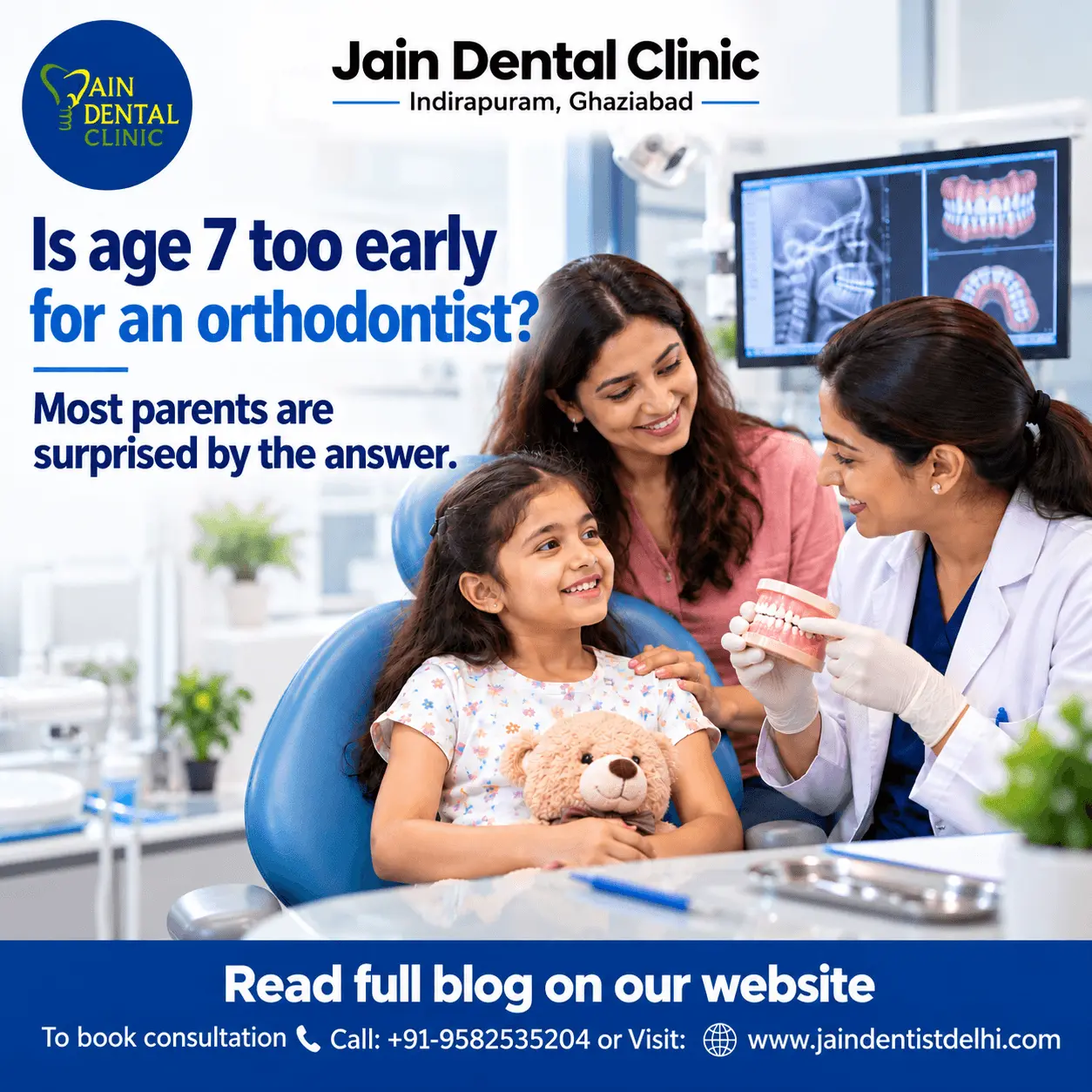
Every child should have a first orthodontic check-up by age 7, according to the American Association of Orthodontists (AAO). Notice the word “by”, not “at”. If you spot a problem earlier, you do not need to wait. This early orthodontic evaluation is only a look, and it does not tie you to any treatment.
So what makes 7 a good age for a first orthodontic visit? Three things are happening in your child’s mouth at once:
- A mix of milk and adult teeth. At 7, children are in the mixed teeth stage, when milk and adult teeth sit side by side. This shows how the adult teeth are lining up.
- The first adult molars are in. These large back teeth arrive around 6 to 7, behind the milk teeth. They set the back bite that other teeth follow.
- The jaw is still growing. Some bite and jaw problems are easier to guide during growth than after it.
The AAO is an American body, but many orthodontists in India follow the same age 7 advice.
Why a Check-Up Helps Even if Teeth Look Straight
Straight front teeth are only part of the picture. An orthodontist also checks how the top and bottom teeth meet, whether there is room for the adult teeth, and whether the jaw shifts when your child bites. Most of this is hard to spot at home.
Age-by-Age Guide: When Should Kids See an Orthodontist?
Every mouth grows at its own pace, so there is no single best age to see an orthodontist for every child. This guide shows what usually happens at each age.
| Age | What is happening in the mouth | What usually happens | Other dental care at this age |
|---|---|---|---|
| Under 6 | Mostly milk teeth. Gaps between them are normal and helpful | No routine orthodontic visit is usually needed unless there is a concern, such as an underbite, crossbite or persistent oral habit like thumb sucking thumb sucking that continues after age 4. | Regular dental check-ups, fluoride toothpaste and professional fluoride treatment when indicated by caries risk. Early childhood caries, cleft palate may require early intervention. |
| 6 to 8 | First adult molars and front teeth come in | First check-up by age 7. Most children only need a plan to watch | The dentist assesses caries risk and newly erupted permanent teeth. Fluoride treatment and sealants may be recommended when clinically appropriate |
| 8 to 10 | More adult front teeth come in, and premolars (the teeth behind the canines) start to arrive. A gap between the upper front teeth is common | Monitoring for a specific problem, such as a crossbite or a narrow upper jaw, Antero- posterior/transverse discrepancy or facial asymmetry. | Preventive dental care continues. Fluoride and sealants may be recommended based on caries risk and the condition of individual teeth. Consultation with Orthodontist is required for any skeletal discrepancy. |
| 10 to 13 | Canines (the pointed corner teeth) and second molars come in. Growth spurt years, usually earlier in girls | A common period for comprehensive orthodontic treatment when indicated, depending on tooth eruption and the child's bite. | Continue routine dental care, including individualized fluoride and sealant recommendations. |
| 13 and up | Most permanent teeth are present, apart from wisdom teeth in many children. | Orthodontic treatment can still be started when appropriate. These ages are a guide, not a deadline | Preventive dental care continues according to the child's individual oral-health needs. |
These ages are a guide, not a deadline. Adults can have orthodontic treatment too.
What Is Normal as Adult Teeth Come In (and When to Get It Checked)
Between about 6 and 9, new teeth can look too big, crooked or gappy. Some dentists call this the “ugly duckling” stage, because it looks messier than it really is. Here is how to tell normal changes from child teeth alignment problems that need a closer look.
| Usually normal | Best to get checked |
|---|---|
| Gaps between milk teeth (also called baby teeth) | Milk teeth packed tight with no gaps, which can mean crowding later |
| A gap between new upper front teeth at 8 to 9 | A wide gap still there after the canines come in, around age 12 |
| Lower adult teeth coming in behind milk teeth, like a "second row" | The milk tooth still firm weeks after the adult tooth came through |
| New adult teeth that look big and a little uneven | Teeth that overlap a lot, or come in far out of line |
| Matching teeth coming in a few months apart | One side's tooth is in, and its match is many months late |
Adult teeth usually arrive in this order:
| Age (approx.) | Adult teeth that usually come in |
|---|---|
| 6 to 7 | First molars and lower front teeth |
| 7 to 8 | Upper front teeth and lower lateral incisors (the teeth next to the two front teeth) |
| 8 to 9 | Upper lateral incisors |
| 9 to 12 | Canines and premolars |
| 11 to 13 | Second molars |
| 17 to 21 | Wisdom teeth, if they come in |
Being a few months ahead or behind is common, and it is not a worry on its own.
Signs Your Child Needs an Orthodontist Before Age 7
Age 7 is a guide, not a rule. So, when should my child see an orthodontist earlier? Book a check-up at any age if you notice any of the signs below. Each is a reason to ask, not proof of a problem, and Jain Dental Clinic sees children under 7.
The first four are the most common orthodontic problems in children.
Crowded or Crooked Teeth
Crowded teeth in children happen when adult teeth lack room, so they overlap or turn. This sometimes settles with growth, and sometimes needs a plan.
Overbite or Front Teeth That Stick Out
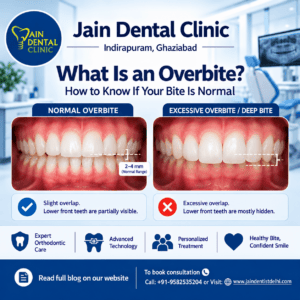
An overbite means the upper front teeth cover too much of the lower ones. Parents also use the word for teeth that stick out. Overbite in children is worth checking, as teeth that stick out chip more easily. Read more on what an overbite looks like
Underbite
In an underbite, the lower front teeth sit in front of the upper ones. Underbite in children is worth an early look, as jaw growth is usually involved, and it can run in families.
Crossbite or a Jaw That Shifts to One Side
In a crossbite, some upper teeth bite inside the lower teeth, and the jaw may slide to one side. Crossbite in children is best checked while the jaw is still growing. It is one of several common bite problems in children
Other Signs to Watch
- Front teeth that do not meet. A gap between the front teeth when the back teeth bite is called an open bite.
- Thumb or finger sucking after about age 4. A habit that continues can push teeth out of place.
- Mouth breathing or snoring. These can be signs of an underlying breathing or sleep-related problem and are worth discussing with your child’s dentist or doctor. Persistent mouth breathing may also be associated with changes in dental and facial development.
- Milk teeth lost too early or too late. Either can disturb where the adult teeth come in.
- An adult tooth coming in out of place. A tooth high in the gum or behind other teeth may not have a clear path.
- Trouble chewing, cheek biting, jaw pain or locking, or an uneven facial appearance. These may be reasons to have your child’s teeth and jaws evaluated.
- Family history. If a parent or sibling had an underbite or braces, your child may have a similar bite.
A Simple Check You Can Do at Home
This two-minute check helps you notice things to mention. It is not a diagnosis.
- Front view. Ask your child to bite on their back teeth and smile. The upper front teeth should sit a little over the lower ones.
- Side view. Do the upper teeth stick far out, or do the lower teeth sit in front?
- Jaw movement. Watch your child open and close slowly. Listen for a click, and look for the jaw moving off to one side.
- Night time. Is their mouth often open, or do they snore?
- Are the adult teeth roughly on time, going by the table above?
Take a photo of anything you notice. Some problems only show on an exam or X-ray, so this check cannot rule them out.
Will a First Check-Up Lead to Braces? Usually Not
Many parents worry that one visit will end with braces. It usually does not. A check-up and treatment are different things, and most children leave with a plan to watch.
After the first visit, your child will usually fall into one of three groups:
- All is fine. Growth looks healthy, and your child needs nothing for now.
- Watch and review. Nothing is needed yet, but growth is worth following. At Jain Dental Clinic, we re-check these children every 6 months.
- Early treatment. A smaller group has a problem where timing matters, such as a crossbite or an underbite. Early orthodontic treatment can guide growth before it gets harder to fix.
This stage is sometimes called Phase 1, a short first round of treatment while some milk teeth are still in. Some children need a second phase in their teens.
Some parents feel milk teeth do not matter, because they fall out anyway. But milk teeth hold space for the adult teeth, and the jaw keeps growing beneath them.
What “Watch and Review” Involves
Watch and review does not mean nothing is being done. According to the AAO, these visits often happen once or twice a year. They check that milk teeth fall out on time, adult teeth come in evenly, there is enough space, and the jaws grow well. The plan changes only if something changes, such as a worsening bite or a tooth stuck under the gum.
Orthodontist, Dentist or Children’s Dentist: Who Should Check Your Child?
Should you see the family dentist, a children’s dentist or an orthodontist? Each plays a different role, and knowing the difference helps you choose. Here is how they compare in India.
| Who | Training | What they do for your child |
|---|---|---|
| Family dentist | BDS, the basic dental degree | Check-ups, cleaning and fillings. Often the first to notice a bite problem |
| Children's dentist | MDS (a specialist master's degree) in Paediatric and Preventive Dentistry | Care for children's teeth, habits and tooth decay |
| Orthodontist | MDS in Orthodontics and Dentofacial Orthopaedics | The specialist for bite, jaw growth, braces and aligners |
So, when it comes to bite and jaw growth, an orthodontist for kids is the right person to see.
- Do you need a referral? You can book an orthodontist directly, and the AAO also says no referral is needed.
- Did your dentist suggest an orthodontist? It simply means they want a specialist’s opinion. It does not mean something is badly wrong.
What Happens at Your Child’s First Orthodontist Visit
A first orthodontist visit for a child is short and gentle. It usually takes about 15 to 20 minutes, so it fits easily around school. It is mostly a check-up and a friendly talk, though the doctor may sometimes address certain dental needs during the same visit.
Here is what usually happens:
- The orthodontist asks about your worries, your child’s habits and health, and any family history of bite problems.
- They check the teeth, bite, jaw, face and breathing, and whether the adult teeth have enough space.
- X-rays may be recommended when clinically indicated, for example, to assess developing teeth that cannot be fully evaluated during the clinical examination. Photos or a digital scan (a 3D picture of the teeth) may also be added.
- Explain. You hear, in plain words, whether all is fine, whether to watch and review, or whether early treatment would help.
What to Bring
Bring any old dental X-rays or reports, a note of habits such as thumb sucking or snoring, and photos of anything you noticed. Mention any family history of braces, and write down your questions so nothing is forgotten.
Questions to Ask the Orthodontist
- Is my child’s bite growing normally?
- Are the adult teeth coming in on time and in the right place?
- Will there be room for the rest of the adult teeth?
- Does anything need attention now, or can we wait?
- If we wait, what will you watch, and when should we come back?
- What changes would mean treatment is needed?
- What could happen if we do not treat now?
If treatment is needed later, would braces or clear aligners suit my child?
Is It Too Late if My Child Is Already 10, 12 or a Teenager?
Not at all. Seven is a useful starting point, not a cut-off. Whether your child is in their pre-teens or teens, a check-up now still helps.
So, when should kids get braces? Most braces and clear aligner treatment starts once most adult teeth are in, often between 10 and 13. An older child is often right on time.
There is one honest point to know. Some jaw problems, like a narrow upper jaw or certain underbites, are easier to guide while a child is growing. So if you have noticed something, do not keep waiting. Even so, many problems are treated very well in the teen years.
Braces or Clear Aligners: What Options Might Your Child Have Later?
You only need to think about this if the orthodontist says treatment would help. If that time comes, these are the main options.
| Option | How it works | Good to know |
|---|---|---|
| Braces | Small metal or tooth-coloured brackets fixed to the teeth and joined by a wire | Work well for most bite and alignment problems |
| Other appliances | Devices such as an expander, which slowly widens a narrow upper jaw | Mostly used in early treatment, during growth |
| Clear aligners | Removable clear trays, such as Invisalign, that move teeth step by step | Must be worn 20 to 22 hours a day, so your child's habits matter |
The right choice depends on the problem, your child’s age, how many adult teeth are in, and how well they will wear aligners. Your orthodontist will explain the options, so you can decide together.
Read next: Are Clear Aligners Suitable for Children and Teens?. You can also learn about clear aligners at Jain Dental Clinic.
Frequently Asked Questions (FAQ) About Teeth Straightening Pain
Here are short answers to common questions from parents.
Is age 5 too early to see an orthodontist?
No, not if you have noticed a sign, such as an underbite, a crossbite or thumb sucking that has not stopped. The usual age for a first orthodontic visit is by 7, but earlier is fine when something looks off. Jain Dental Clinic sees children under 7.
Can a 7-year-old get braces?
Yes, but most 7-year-olds do not need them. At this age, most children only need a plan to watch their growth. A smaller group with a specific problem, such as a crossbite, may need short early treatment. Full braces usually wait until most adult teeth are in.
Does every child need early orthodontic treatment?
No. Most children do not need it. Early treatment is only for a smaller group with a problem where timing matters, such as a crossbite or an underbite. Others may only need a check-up every 6 months, so the orthodontist can follow their growth.
Do gaps in milk teeth mean my child will need braces?
No. Gaps between milk teeth are normal and even helpful, because they make room for the bigger adult teeth. In fact, milk teeth packed tightly with no gaps are more likely to point to crowding later. If you are unsure, a quick check can settle it.
What is the best age for braces?
There is no single best age, but many children start braces or clear aligners between 10 and 13, once most adult teeth are in. Some children need treatment earlier, and teenagers can start later. Your orthodontist will suggest the right time for your child.
Can children wear clear aligners?
Yes, clear aligners can work well for older children and teens once most adult teeth are in. They must be worn 20 to 22 hours a day, so your child needs to be ready for that. The orthodontist will tell you whether aligners suit your child.
Does the first orthodontic check-up hurt?
The check-up itself is gentle, and most children find it easy. It is a short visit of about 15 to 20 minutes, with a look at the teeth, a friendly talk and X-rays are taken only if needed. Explaining the visit calmly beforehand helps your child feel relaxed.
Conclusion
So, what age should a child see an orthodontist? For most children, by age 7, but what you notice matters too. Here is a simple way to decide:
- Before 7: Do not wait if you notice a sign, such as an underbite, a crossbite or thumb sucking that continues.
- Around 7: Book the first check-up, even if the teeth look straight.
- After 7: A check-up is still worth it, even for older children and teens.
- After the check-up: Your child may need nothing, a plan to watch, or treatment. Each one is a useful answer.
Whatever your child’s age, one short visit can replace guesswork with a clear plan.
Schedule Your Consultation Today
Find Out How Your Child’s Teeth Are Really Growing
Now that you know the first orthodontic check-up should happen by age 7 — sooner if you notice a sign such as crowding, a crossbite or thumb sucking that continues, and still worthwhile if your child is already older — the next step is understanding what is happening in your own child’s mouth. How the adult teeth are coming in, whether there is enough space for them, and how the jaws are growing all decide whether your child needs nothing for now, a plan to watch, or treatment at the right time. Since every child grows at their own pace, a professional orthodontic evaluation is the clearest way to know where your child stands.
At Jain Dental Clinic, Dr. Arpan Pavaiya Jain and Dr. Rashi Agarwal Jain can check your child’s bite, jaw growth, how the adult teeth are coming in, and habits such as thumb sucking or mouth breathing. Whether you have spotted a gap or a crooked tooth, your family dentist has suggested an orthodontist, your child is under 7 and something looks off, or your pre-teen has never had a check-up, our team can explain what we see in plain words. Depending on your child’s needs, the next step may be no treatment at all, a review every 6 months, early treatment, or braces or clear aligners later on — and as an authorized Invisalign provider, the clinic can guide you on aligners when the time is right.
📞 Call: +91-9582535204 🌐 Visit: www.jaindentistdelhi.com
Medical Advice Disclaimer:
The information provided in this article is for general educational and informational purposes only and is not intended as professional medical or dental advice, diagnosis, or treatment. While we strive for accuracy, every patient’s dental anatomy and clinical needs are unique. Always seek the advice of your dentist or another qualified healthcare provider with any questions you may have regarding a medical condition. Never disregard professional medical advice or delay seeking it because of something you have read on this website

Dr. Arpan Pavaiya Jain, Director of Jain Dental Clinic, Indirapuram, Ghaziabad is a renowned Prosthodontist and Implantologist with over 25 years of expertise in advanced dentistry. A graduate of the prestigious King George’s Medical College Lucknow, he has performed more than 20,000 successful dental implant procedures. Dr. Arpan Pavaiya Jain leads a team of skilled professionals, offering state-of-the-art treatments in dental implants, clear aligners, cosmetic dentistry, orthodontics, and more. Known for his personalized care and commitment to excellence, he has earned a reputation as a trusted dental expert in Indirapuram, Ghaziabad.